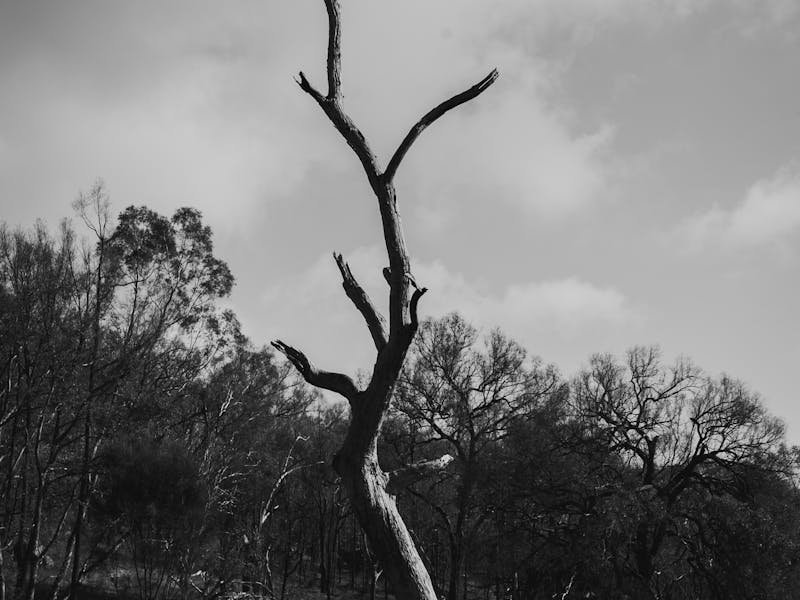
Every winter in Huntsville, we get calls from homeowners who are staring at a bare tree in their yard and wondering if it is done for. It is a fair question. When a deciduous tree drops its leaves in November and stands there looking like a skeleton for four months, it is hard to know whether you are looking at a tree that is resting or a tree that is never waking up.
The thing is, this question matters more than people realize. A dead tree is not just an eyesore. It is a hazard. Dead wood becomes brittle over time, and large branches (or the whole tree) can come down with no warning at all. We have seen dead trees stand for a year or two looking stable, then drop a massive limb on a calm afternoon because the wood finally gave out. On the other hand, you do not want to pay for tree removal on something that would have leafed out just fine in April.
So here is how to figure out what you are actually dealing with. These are the same checks we run when a homeowner calls us worried about a tree, and most of them require nothing more than your hands and about ten minutes.
Why this comes up so often in Alabama
North Alabama has a climate that makes this question trickier than it would be in, say, Michigan or Maine. Our winters are mild enough that some trees hold their leaves well into December, while others drop them early. We get warm spells in January and February that can trick early-budding species into pushing out growth, followed by a hard freeze that kills those new buds and makes the tree look worse than it did before.
We also have a wide mix of deciduous and evergreen species growing side by side. Your neighbor's magnolia and loblolly pines stay green all winter. Your red oak and hickory go completely bare. If you moved here from somewhere else, you might not be calibrated to what "normal winter" looks like for Alabama trees.
Add to that the fact that Huntsville's clay soil puts stress on root systems, and our spring storms can damage trees in ways that do not show up until the following year. A tree that took a lightning hit or had roots damaged during a summer construction project might look fine through fall, lose its leaves on schedule, and then just never come back in the spring. That is the scenario that catches people off guard.
The scratch test
This is the single most useful thing you can do, and honestly, it is the one most people have never heard of. It takes about thirty seconds and gives you a pretty clear answer.
Pick a branch on the tree. Not a thick one at the base, but a younger branch, maybe the thickness of your finger or a pencil. Using your fingernail, a pocket knife, or even a coin, scratch away a small section of the outer bark. You only need to remove a thin strip, maybe half an inch long.
What you are looking for is the layer just under the bark called the cambium. On a living branch, this layer will be green or greenish-white and moist. It might even feel slightly slippery. That green means there is active living tissue in the branch, and the tree is alive in that area.
On a dead branch, you will see brown or tan tissue that looks dry and feels dry. There is no moisture, no green, nothing that suggests life. The texture is papery or brittle rather than smooth and damp.
Now here is the important part: do not do this test on just one branch and call it a day. A single dead branch does not mean the whole tree is dead. Trees lose individual branches all the time for various reasons. What you want is a sample from several spots around the tree. Try branches on different sides and at different heights if you can reach them safely. If every branch you test comes back brown and dry, the tree is almost certainly dead. If some are green and some are brown, you might be dealing with partial dieback, which is a different situation (more on that below).
For the scratch test to be most reliable, do it during late winter or early spring, after the coldest weather has passed. In the Huntsville area, late February through March is a good window. The tree should be starting to mobilize resources even if it has not leafed out yet, so that green cambium layer will be visible if the tree is alive.
The snap test
This one is even simpler. Find a small twig at the end of a branch. Something about the diameter of a pencil or thinner. Bend it between your fingers.
A living twig will flex. It bends and feels supple, like green wood. You might even see fibers stretching if you bend it far enough. It resists snapping.
A dead twig snaps cleanly. There is a dry crack, like breaking a pretzel stick. The break is clean and the wood inside looks gray or brown, with no visible moisture. Sometimes dead twigs are so brittle they break just from light pressure.
Same rule applies here. Test multiple spots around the tree. If every twig you try snaps dry, that is a bad sign. If some flex and some snap, you have partial dieback happening.
One thing to keep in mind: some species have naturally more brittle wood than others, even when alive. Bradford pears (which are all over Huntsville, unfortunately) and certain maples can snap more easily than, say, a young willow branch. So the snap test works best when combined with the scratch test rather than on its own.
Check for buds
This test works best in late winter and early spring, which in our area means February and March. Before a deciduous tree leafs out, it sets buds. These are small, compact structures at the tips of branches and along the stems where new leaves will emerge.
On a living tree, buds will be visible even in winter. They are usually small and tight, sometimes with a slight sheen or color to them. Red maples have reddish buds. Oaks have clusters of buds at the branch tips. Hickories have large, scaled buds that are actually pretty distinctive once you know what to look for.
On a dead tree, there are no buds. Or if there are remnants of old buds from the previous year, they will be shriveled, black, and dry. They crumble when you touch them instead of feeling firm.
This is a really useful check in March around Huntsville. By mid-March, most of our deciduous species should be showing visible bud swell, meaning the buds are plumping up and getting ready to open. Walk around your neighborhood and look at the same species of tree on other properties. If every red maple on your street has fat reddish buds and yours has nothing, that tells you something.
Look at the bark
Bark can tell you a lot about what is happening inside a tree, if you know what to look for.
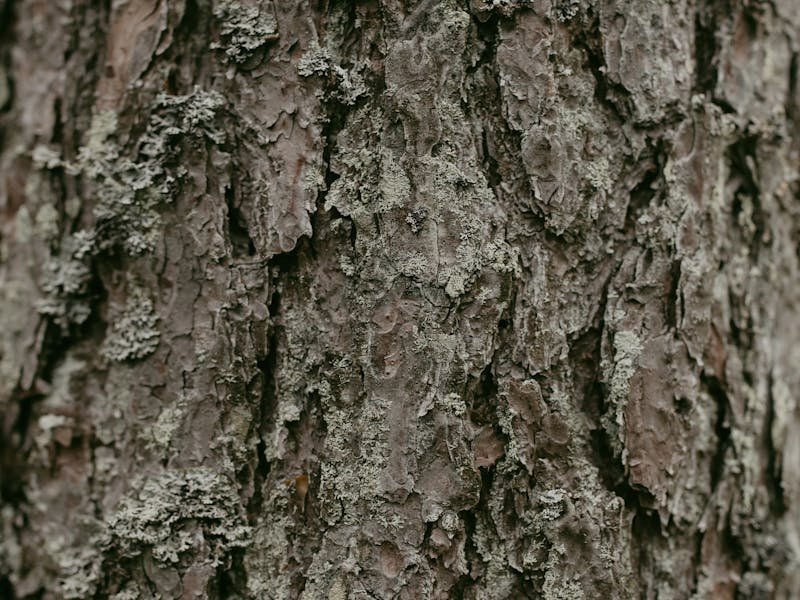
Healthy bark fits tightly to the trunk and major branches. It has texture and character specific to the species, whether that is the deep furrows of a mature oak, the smooth gray skin of a beech, or the plated patterns on a loblolly pine. The key thing is that it is attached.
On a dead or dying tree, bark often starts separating from the wood underneath. You might see sections peeling away in sheets, leaving smooth, bare wood exposed. Sometimes the bark develops vertical cracks that deepen over time, wider than what you would expect from normal growth patterns. Press on a loose section and it might crumble or fall off in your hand.
A couple of caveats. Some species shed bark naturally as they grow. Sycamores are famous for this, dropping large patches of outer bark to reveal the pale inner bark beneath. River birch peels in papery curls. That is normal for those species. But if you have an oak, maple, or hickory losing bark in large pieces, that is not normal, and it usually means the tissue underneath has died.
Also look for cankers, which are sunken, discolored areas in the bark where a disease has killed a section of the cambium. Cankers can girdle a branch or trunk if they grow large enough, cutting off the flow of nutrients. A tree with large cankers on the main trunk is in serious trouble whether it is technically "dead" yet or not.
Fungal growth at the base
If you see mushrooms or bracket fungi growing at the base of your tree or on surface roots, you are looking at a different problem than simple dormancy. Dormant trees do not sprout mushrooms just because they have lost their leaves. Fungal fruiting bodies at the base mean there is active decay happening inside the roots or lower trunk.
This does not automatically mean the tree is dead. Plenty of trees have internal decay and still push out leaves and grow for years. But it does mean the tree's structural integrity is compromised, and it is slowly losing the battle. The wood that holds the tree up is being consumed from the inside.
In the Huntsville area, our wet springs create ideal conditions for fungal growth. Honey mushrooms (Armillaria) are extremely common here and are one of the most destructive root rot organisms around. If you see clusters of tan, honey-colored mushrooms at the base of your tree in fall or after rain, that tree needs a closer look from someone who can evaluate how much sound wood is left. You can read more about signs a tree needs to be removed for the full picture on fungal indicators.
Root problems you can see from the surface
Most of a tree's root system is invisible, but some root problems show up above ground. Heaving soil on one side of the tree, where the ground has cracked or lifted, suggests the root plate is shifting. That means anchorage failure, not dormancy.
Exposed roots that are soft, discolored, or crumbling when you touch them indicate root death. Healthy roots are firm and pale on the inside if you nick them. Dead roots are dark, mushy, or dry and brittle depending on whether they rotted from moisture or dried out.
Girdling roots are another thing to watch for. These are roots that wrap around the base of the trunk instead of growing outward. Over time, they strangle the trunk, cutting off the flow of water and nutrients. A tree with girdling roots may leaf out weakly for a few years with progressively thinner canopy before finally dying. If your tree has been getting a little worse each spring, look at the root flare (where the trunk meets the ground) and see if there are roots visibly wrapping around it.
When the tree only leafs out on one side
This is one that people notice in April and May and do not know what to make of. Half the tree looks fine, green and full. The other half is bare. What is going on?
Partial dieback usually means there is damage on the affected side. Could be root loss on that side (maybe from construction, grade changes, or soil compaction). Could be vascular disease blocking the flow of water and nutrients to those branches. Could be a canker on the trunk that has killed the cambium on one side, cutting off the supply line to the branches above it.
A tree with one dead side is not necessarily doomed. If the cause is something like a single severed root from a driveway repair, and the rest of the root system is intact, the tree might stabilize. A good pruning of the dead wood reduces the hazard from falling branches and lets the tree redirect its energy to the living portion.
But a tree that loses a little more each year, where the dead zone is expanding season after season, is telling you it is on a downward trajectory. You can keep trimming back the dead portions as they appear, but at some point you are just managing the decline of a tree that is not going to recover.
Alabama timing: when to actually start worrying
This is the part that is specific to where we live, and it matters a lot for getting the timing right.
In the Huntsville area, most deciduous trees start showing visible signs of life (bud swell, new leaf emergence) between mid-March and mid-April. Red maples are among the earliest, often blooming as early as late February. Oaks tend to be later, sometimes not fully leafing out until the first or second week of April. Pecans are notoriously slow and might not leaf out until late April.
So if it is February and your tree is bare, relax. That is normal.
If it is mid-March and you see buds forming on similar trees around the neighborhood but not on yours, start paying attention. Do the scratch test. Check the twigs.
If it is mid-April and your tree has zero buds, zero leaf emergence, and every other tree of the same species in the area is greening up, the odds are not good. Run all the tests described above.
If it is May and your tree still has nothing, while everything else around it has a full canopy, it is almost certainly dead. There are very few deciduous species in North Alabama that would not be leafed out by May. At that point, you are no longer wondering. You are confirming what you already suspect.
One exception: trees that experienced severe stress the previous year (bad drought, storm damage, heavy construction nearby) sometimes leaf out very late or push out a weak, sparse canopy. If your tree had a rough year and is slow to start, give it a few extra weeks. But keep testing the cambium. As long as you are finding green under the bark, the tree is still trying.
What to do if you think your tree is dead
If you have run the scratch test on multiple branches and found nothing but brown, dry tissue, if every twig snaps clean, if there are no buds and it is May, then yes, your tree is very likely dead. Here is what to do next.
Do not just leave it there. This is the part where people get into trouble. A dead tree does not stay stable forever. The wood decays, the roots rot, and the structural integrity deteriorates with every passing month. A dead tree that has been standing for two years is significantly more dangerous than one that died recently, because the internal decay has had time to progress.
Get someone who knows trees to come look at it. Not because you need a second opinion on whether it is dead (the tests above are pretty definitive), but because you need an assessment of how urgent the removal is. A dead tree in the middle of a large yard, away from structures and foot traffic, is a lower priority than a dead tree overhanging your roof or standing next to where your kids play. Location determines urgency.
Think about what is under it and around it. Dead trees shed branches unpredictably. If there is a car, a walkway, a fence, a play structure, or anything else of value in the drop zone, that changes the risk calculation. In Huntsville, where we get severe thunderstorms regularly from March through June, a dead tree near a structure is a problem you want solved before storm season, not during it.
Also worth knowing: dead trees get harder and more expensive to remove the longer they stand. When a tree first dies, the wood is still relatively sound and a crew can work it efficiently. After a year or two of decay, the wood becomes unpredictable. Branches that look solid might be hollow. The trunk might be structurally compromised in ways that are not visible from the outside. All of that makes the removal process more complicated and more dangerous for the crew, which means it costs more.
We get calls every year from people who noticed a dead tree two winters ago and kept putting off dealing with it. Then a storm knocks it onto something, or a big limb drops on a car, and suddenly it is an emergency that costs twice what a planned removal would have.
Frequently asked questions
How can I tell if my tree is dead or just dormant?
The most reliable method is the scratch test. Use your fingernail or a knife to scratch away a small section of bark on a young branch. If you see green, moist tissue underneath, the tree is alive. Brown, dry tissue means that branch is dead. Test multiple branches around the tree to get the full picture. You can also try the snap test: living twigs bend and flex, while dead twigs snap cleanly with a dry crack.
When should I worry if my tree has no leaves in Alabama?
In the Huntsville area, most deciduous trees begin leafing out between mid-March and mid-April. If your tree shows no buds or leaf growth by early May, and other trees of the same species in your area have full canopies, it is very likely dead. Some species like pecans and certain oaks leaf out later than others, so compare yours to the same species in your neighborhood rather than to different types of trees.
Can a tree be half dead and half alive?
Yes. Partial dieback, where one side of the tree produces leaves and the other side is bare, is fairly common. It usually indicates internal damage, vascular disease, or root loss on the affected side. Sometimes the tree can be managed by pruning the dead portions. Other times, the dead zone keeps expanding each year, which means the tree is declining and will eventually need removal.
Do mushrooms at the base mean my tree is dead?
Not necessarily, but they do mean there is internal decay happening. Mushrooms at the base are the visible sign of fungi breaking down wood inside the roots or lower trunk. A tree can still have living branches while its base is rotting from the inside. This is actually a more dangerous situation than a fully dead tree in some ways, because the tree still has a heavy, leaf-bearing canopy supported by a structurally weakened trunk and root system.
Should I remove a tree that I think is dead?
If you have confirmed the tree is dead using the scratch test and snap test on multiple branches, removal is the right call. Dead trees become more brittle and unpredictable every month. They shed branches without warning and can topple in storms. The longer you wait, the more dangerous and expensive the removal becomes. Have it evaluated by someone who can assess the urgency based on the tree's location relative to structures, walkways, and other targets.