Tree trimming in Huntsville, Alabama
Tree trimming in Huntsville, AL on a regular schedule keeps your trees healthier, makes them hold up better in storms, and honestly just makes your yard look nicer. We handle trimming and pruning for all the tree species you'll find around North Alabama.
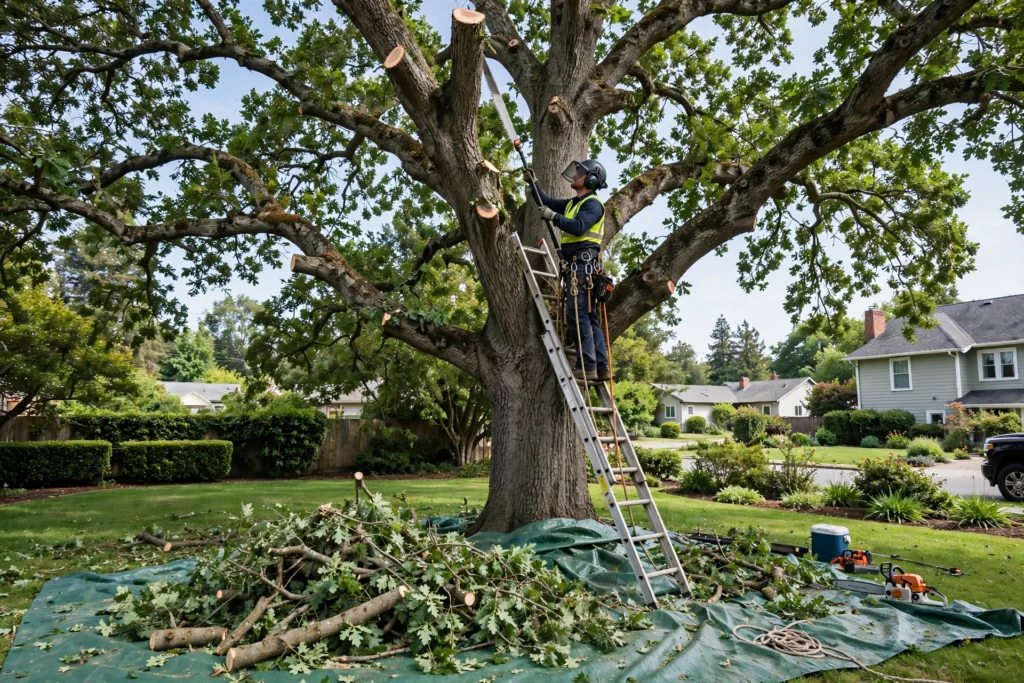
We follow ISA (International Society of Arboriculture) pruning standards, which means every cut is made in a way that helps the tree heal properly and keep its natural shape. No topping, no hacking.
What we do
- Crown thinning – we take out select branches so the canopy isn't so thick. Lets more light through and helps the tree handle wind better during storms.
- Crown raising – removing the lower branches so you have clearance over walkways, driveways, and around your house.
- Crown reduction – bringing the overall size of the canopy down without ruining the tree's shape.
- Deadwood removal – getting rid of dead, dying, or diseased branches before they fall on something (or someone).
- Structural pruning – fixing growth problems in younger trees so they develop a solid branch structure as they get bigger.
- Vista pruning – trimming to open up a view without hurting the tree.
- Clearance pruning – cutting branches back from your roof, gutters, power lines, and other structures.
Why trimming matters here in Huntsville
Huntsville sits in Dixie Alley, which is one of the most storm-prone areas in the country. Trees that get trimmed regularly hold up much better in high winds than ones that don't. Here's why it matters:
- A thinned crown lets wind pass through instead of catching it like a sail. That means less chance of the tree coming down in a storm.
- Branches that grow too close to your roof, siding, or gutters cause damage over time, especially when the wind picks up.
- Taking out dead or diseased branches stops decay from spreading and lets more sunlight and air reach the healthy parts of the canopy.
- Dead branches can fall without warning. You don't want one landing on someone walking through your yard.
- Well-kept trees can raise your property value by 7–19% according to the USDA Forest Service.
Tree trimming cost in Huntsville
What you'll pay depends on the tree's size, what kind it is, its condition, and how easy it is to get to:
- Small trees (under 30 feet): $150 – $400
- Medium trees (30–60 feet): $400 – $800
- Large trees (60+ feet): $800 – $1,500+
Most trees do well with trimming every 2–3 years. Give us a call and we'll come out and give you a free estimate.
Call (256) 555-0123 for a free, no-obligation estimate.
Best time to trim trees in Alabama
Late winter to early spring (February–March) is the best window for most trimming around North Alabama. The trees are still dormant, so they heal up fast once spring growth kicks in. That said, if you've got dead branches or something dangerous, don't wait – we'll take care of it any time of year.
Huntsville yards are packed with tulip poplars, silver maples, sweetgums, oaks, and hickories — many of them fast growers that need trimming every 2 to 3 years to stay healthy in North Alabama's climate. Since Huntsville sits in Dixie Alley, one of the most storm-prone areas in the country, routine trimming helps trees hold up in high winds before storm season arrives.
Signs your tree needs trimming
Not sure if your trees need work? Here are some things to look for:
- Dead or broken branches – You can usually spot dead branches because they won't have leaves during the growing season, and the bark is peeling or gone. Broken branches hanging in the canopy (sometimes called widow-makers) need to come down right away since they can drop without warning.
- Branches touching your roof or house – If branches are resting on or rubbing against your roof, gutters, or siding, they're doing damage every time the wind blows. They also give squirrels, ants, and raccoons a way onto your house. You want at least 6 to 10 feet of clearance.
- Overgrown or crossing branches – Branches that rub against each other create wounds that let in disease and decay. A canopy that's gotten too thick also blocks sunlight from reaching your lawn.
- Really dense canopy – If you can barely see through the tree's canopy, it's too thick. All that density catches wind like a sail during storms, which makes the whole tree more likely to come down. Crown thinning takes care of this.
- Low-hanging branches in the way – Branches hanging over walkways, driveways, patios, or where kids play are annoying and can be dangerous. Crown raising takes off the lower limbs to give you clearance.
- Signs of disease or fungus – Cankers, mushrooms growing on branches, leaves that are discolored or wilting on certain limbs, or unusual growths can all mean disease. Removing the affected branches early can keep the problem from spreading.
- It's been more than 3 years – If you can't remember when the trees were last trimmed, they're probably overdue. Getting them trimmed every 2 to 3 years keeps small issues from turning into big, expensive ones.
- Blocked views or light – If a tree has grown to block your view, your security cameras, or the natural light coming into your house, we can trim it back without hurting the tree.
If any of this sounds like your yard, give us a call. We'll come take a look at your trees and let you know what they need.
The Difference Between Pruning and Trimming
Homeowners often use the terms "pruning" and "trimming" interchangeably, and in casual conversation that is perfectly fine. However, in professional arboriculture, there is an important distinction that affects how the work is approached and how the tree responds.
Pruning is a targeted, science-based practice focused on the tree's health and structural integrity. Each branch selected for removal is chosen for a specific reason: it is dead, diseased, crossing another branch, creating a structural weakness, growing in an undesirable direction, or interfering with a structure or utility line. Pruning requires knowledge of tree biology, species-specific growth patterns, and proper cutting techniques. The goal is to improve the tree's long-term health and structure.
Trimming generally refers to maintenance cutting focused on appearance, particularly for hedges, shrubs, and ornamental plants. When applied to trees, "trimming" usually means reducing the canopy size or shaping the tree for aesthetic purposes. A good arborist approaches even cosmetic trimming with pruning principles, ensuring that cuts are made properly and the tree's health is not compromised for the sake of appearance.
At Huntsville Tree Pros, we apply pruning science to every tree care job regardless of what the customer calls it. When you call and ask for a "tree trimming," you get the same quality work and proper technique as when someone requests "structural pruning." The terminology does not change our standards. For more about our trimming services, visit our tree trimming page.
Types of Pruning Cuts
Understanding the different types of pruning cuts helps you appreciate why professional pruning produces better results than indiscriminate cutting. Each type of cut has a specific purpose and is used in specific situations:
Cleaning
Cleaning is the removal of dead, dying, diseased, crowded, and weakly attached branches from the crown of a tree. This is the most basic and universally beneficial type of pruning. Every tree on every property benefits from periodic cleaning. Dead branches attract wood-boring insects, harbor fungal diseases, and can fall without warning. Diseased branches, if left in place, allow infections to spread to healthy parts of the tree. Cleaning can be performed at any time of year and is often the only type of pruning mature trees need.
Thinning
Thinning is the selective removal of live branches to reduce the density of the canopy without changing the tree's overall size or shape. Proper thinning opens up the canopy to allow more light penetration and air circulation, which reduces disease pressure and encourages healthier growth throughout the crown. Thinning also reduces wind resistance, which decreases the chance of branch failure during storms.
Proper thinning removes no more than 15 to 25 percent of the live canopy and distributes the cuts evenly throughout the crown. Over-thinning, sometimes called "lion-tailing" because it strips all the inner branches leaving growth only at the tips, is harmful and creates branches that are more prone to breaking.
Raising
Raising is the removal of lower branches to increase the clearance between the ground and the bottom of the canopy. This is commonly done to provide clearance for pedestrians, vehicles, structures, sight lines, and lawn maintenance equipment. In Huntsville, raising is frequently needed when branches grow down over driveways, sidewalks, and streets.
For shade trees in residential yards, a clearance of 8 feet is generally sufficient for walking underneath, while 14 to 15 feet of clearance is needed over streets and driveways to accommodate trucks and equipment.
Reduction
Crown reduction decreases the overall height or spread of a tree by cutting branches back to an adequate lateral branch that can assume the terminal role. This is very different from topping, which makes indiscriminate cuts that leave stubs. Proper reduction cuts are made just above a lateral branch that is at least one-third the diameter of the branch being removed. This allows the lateral to take over as the new leader, maintaining the tree's natural form at a reduced size.
Crown reduction is the appropriate technique when a tree has outgrown its space and needs to be made smaller. It is more expensive and time-consuming than topping, but it produces a tree that looks natural, heals properly, and does not generate the hazardous, weakly attached regrowth that topped trees produce.
Structural Pruning (for Young Trees)
Structural pruning is the most valuable and most overlooked type of pruning. It is performed on young trees to establish a strong branch architecture that will serve the tree throughout its life. By selecting a central leader, establishing proper branch spacing, and removing or reducing competing stems when the tree is young, we prevent the structural defects that lead to expensive cabling, bracing, or removal decades later.
A single structural pruning session on a young tree costs a fraction of what it costs to address structural problems in a mature tree. If you have recently planted trees, scheduling structural pruning within the first 3 to 5 years is one of the best investments you can make.
Pruning for Fruit Trees
Fruit trees in Huntsville require annual pruning to maintain productivity, manage size, and prevent disease. Without regular pruning, fruit trees become overgrown, produce smaller and fewer fruits, and are more susceptible to diseases like brown rot, fire blight, and apple scab.
Our fruit tree pruning services cover the most common fruit trees grown in the Huntsville area:
- Apple trees — Pruned in late winter (January to February) to maintain an open center or central leader form. We remove water sprouts, crossing branches, and dead wood, and thin the canopy to allow sunlight to reach developing fruit
- Peach trees — Pruned in late winter using an open vase shape. Peach trees produce fruit on one-year-old wood, so annual pruning is essential to stimulate new productive growth and prevent the bearing surface from moving too far from the trunk
- Pear trees — Pruned in late winter with careful attention to fire blight management. Infected branches are removed with cuts made at least 12 inches below the visible infection, and tools are sanitized between each cut
- Fig trees — Light pruning in late winter to remove dead wood, crossing branches, and suckers. Figs in Huntsville can occasionally suffer winter dieback, and dead material should be removed in spring after new growth reveals the extent of damage
- Persimmon trees — Minimal pruning needed. Focus on removing dead wood, water sprouts, and crossing branches to maintain good form and light penetration
Pruning for Ornamental Trees
Ornamental trees are the focal points of residential landscapes in Huntsville. Proper pruning enhances their natural beauty, promotes abundant flowering, and maintains an attractive form. Each type of ornamental tree has its own pruning requirements:
Crepe Myrtle Pruning
Crepe myrtles are the most popular ornamental tree in Huntsville, and unfortunately, they are also the most abused. The practice of severely cutting crepe myrtles back to thick stubs each year, commonly called "crepe murder," is one of the most harmful and unnecessary tree care practices still widely performed in the southeast.
Proper crepe myrtle pruning involves removing spent seed pods to encourage reblooming, cutting out crossing branches and inward-growing stems, removing suckers from the base and lower trunk, thinning the canopy lightly to improve air circulation and reduce powdery mildew, and removing dead or damaged branches.
Crepe myrtles bloom on new growth, so they will flower regardless of whether they are pruned. Light pruning in late February maintains the tree's natural, graceful form while still encouraging vigorous new flowering stems. There is never a reason to cut a crepe myrtle trunk back to stubs. For a complete guide, read our blog post on crepe myrtle care and pruning in Huntsville.
Dogwood Pruning
Flowering dogwoods should be pruned immediately after flowering in late spring. This timing preserves next year's flower buds, which begin forming in summer. Pruning focuses on removing dead branches, crossing limbs, and low-hanging branches. Dogwoods are susceptible to dogwood anthracnose, so maintaining good air circulation through the canopy is particularly important.
Japanese Maple Pruning
Japanese maples are best pruned in late winter while dormant. The goal is to enhance the tree's natural layered form by removing inward-growing branches, thinning dense areas, and eliminating any branches that detract from the desired shape. Light, selective pruning every two to three years keeps Japanese maples looking their best.
Redbud Pruning
Eastern redbuds should be pruned after flowering in spring. Remove dead branches, crossing limbs, and any competing leaders. Redbuds tend to develop multiple trunks, so selecting and maintaining a single leader when the tree is young produces a stronger, more attractive specimen.
Warning Signs of Bad Pruning
Unfortunately, many tree service companies in the Huntsville area still practice poor pruning techniques. Knowing what to watch out for can help you avoid hiring a company that will harm your trees:
- Topping — Cutting main branches back to stubs. This is the most damaging pruning practice and is never acceptable for any tree species
- Lion-tailing — Stripping all inner branches and foliage, leaving growth only at branch tips. This creates branches that act like lever arms and are more likely to break
- Flush cuts — Cutting branches flush against the trunk rather than just outside the branch collar. This destroys the tree's natural wound-closure mechanism and leads to internal decay
- Leaving stubs — Cutting branches too far from the trunk, leaving long stubs that die back and become entry points for decay
- Over-pruning — Removing more than 25 percent of the live canopy in a single session. This starves the tree and triggers stress responses
- Using climbing spikes on living trees — Spike climbing creates puncture wounds on the trunk that can introduce disease. Spikes should only be used on trees being removed, never on trees being pruned
Frequently asked questions
How much does tree trimming cost in Huntsville, AL?
+It depends on the size of the tree, what kind it is, its condition, and how easy it is to reach. Small trees under 30 feet usually run $150 to $400. Medium trees (30 to 60 feet) are typically $400 to $800. Large trees over 60 feet run $800 to $1,500 or more. If you've got multiple trees, we can usually work out a discount. We always come out and give you a free estimate before starting anything.
When is the best time to trim trees in Huntsville?
+Late winter to early spring – usually February through March – while the trees are still dormant. Trimming then puts less stress on the tree, and the cuts heal up fast once spring growth starts. But if you've got dead branches or a hazard, don't wait for the right season. Call us and we'll handle it.
How often should I have my trees trimmed?
+Every 2 to 3 years works for most trees around Huntsville. Fast growers like tulip poplars, silver maples, and sweetgums might need it more often. Slower-growing oaks and hickories can sometimes go 3 to 5 years between trimmings. If you have younger trees, annual structural pruning helps them develop strong branches that hold up better in storms down the road.
Will trimming hurt my tree?
+Not when it's done right. Good trimming actually helps the tree by getting rid of dead, diseased, and competing branches. We follow ISA pruning standards and never take off more than 25 percent of the live canopy in one visit. Bad techniques like topping or lion-tailing can seriously damage or kill a tree, which is why it matters who you hire.
Can you trim branches away from my roof and power lines?
+Yes, that's actually one of our most common jobs. We trim branches back from roofs, gutters, siding, fences, and outbuildings all over Huntsville. For branches near power lines, there are specific safety rules we have to follow. We coordinate with Huntsville Utilities when needed and have the right equipment and insurance to do the work safely.
What is the difference between tree trimming and tree pruning?
+Most people use the words interchangeably, and that's fine. Technically, trimming is more about appearance and clearance, while pruning focuses on the tree's health and structure. In practice, we do both at the same time. We look at what each tree needs and make the right cuts for both health and looks.