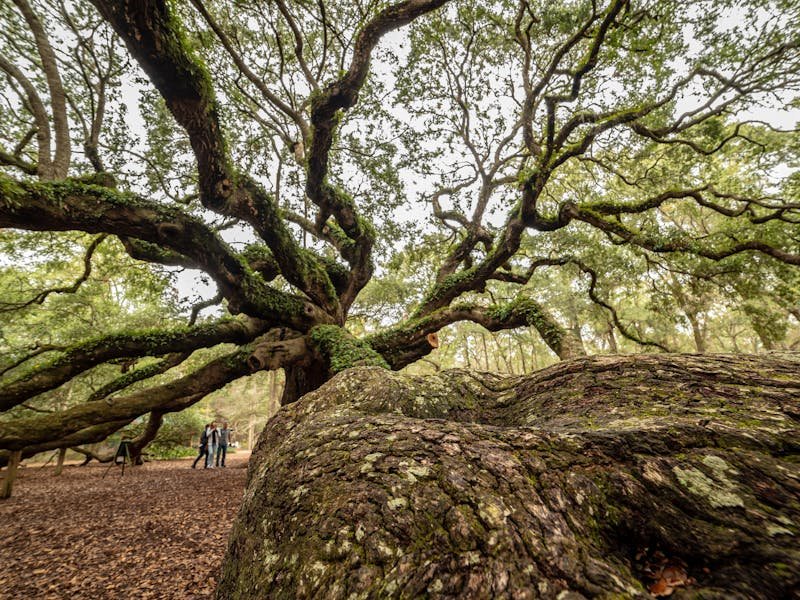
If you have spent any time driving through the older neighborhoods of Huntsville, you have seen them: massive oaks with canopies that stretch across entire yards, trunks so thick it would take two or three people to wrap their arms around, and root systems that buckle sidewalks and dominate entire landscapes. Oak trees are, without exaggeration, the backbone of Huntsville's urban forest. They shade our streets, anchor our neighborhoods, and give areas like Blossomwood, Twickenham, Five Points, and Monte Sano their character.
Our crew has worked with oak trees across every corner of the Huntsville metro area, from century-old white oaks in the historic districts to young red oaks that were planted when subdivisions in Madison and Hampton Cove were first developed. We have treated diseased oaks, pruned healthy ones, braced aging ones, and yes, we have removed plenty that had reached the end of the road. Through all of that, we have developed a deep respect for these trees and a pretty thorough understanding of what makes them thrive and what causes them to fail in our specific soil and climate.
This guide is for every Huntsville homeowner who has an oak tree on their property, which based on our experience is a pretty large percentage of you. We will walk you through the different oak species you are likely to encounter, how to identify each one, what care they need, what diseases to watch for, when and how to prune, and how to make the tough call about whether an aging or declining oak needs to come down.
The Oak Species You Will Find in Huntsville
Not all oaks are created equal, and knowing which species you have on your property is the first step toward understanding its needs, its lifespan, and its potential problems. Here are the oaks you are most likely to encounter in the Huntsville, Alabama metro area.
Southern Red Oak (Quercus falcata)
The Southern Red Oak is probably the most common oak species in the Huntsville area, and for good reason. It is native to North Alabama, it grows well in our red clay soil, it handles our hot, humid summers without complaint, and it develops into a stately tree with a broad, rounded canopy that can spread 60 to 80 feet wide at maturity.
You can identify a Southern Red Oak by its leaves, which have deeply cut lobes with bristle tips, kind of like a hand with long, pointed fingers. The bark on mature trees is dark gray to almost black with deep furrows and rough ridges. The acorns are small, about half an inch, with a shallow cap that covers about a third of the nut.
Southern Red Oaks are long-lived trees, commonly reaching 150 to 300 years. They grow to 60 to 80 feet tall and prefer well-drained soils, though they tolerate the clay conditions found throughout most of Huntsville and Madison County. You will find magnificent specimens throughout the older neighborhoods of South Huntsville, along Monte Sano Boulevard, and scattered through the wooded lots in Hampton Cove and Bailey Cove.
White Oak (Quercus alba)
The White Oak is, in our crew's opinion, the king of Alabama's oak trees. It is a slow grower compared to some of the red oak group, but what it lacks in speed it makes up for in longevity, strength, and sheer beauty. A mature white oak with its broad, spreading crown and light gray, shaggy bark is one of the most impressive sights in any landscape.
White Oak leaves are easy to identify because they have rounded lobes without any bristle tips, which immediately distinguishes them from the red oak group. The leaves are a rich green in summer and turn shades of deep red, wine, and brown in fall, often holding onto the tree well into winter. The bark is light gray with loose, scaly plates, and the acorns are longer than they are wide with a warty cap covering about a quarter of the nut.
White Oaks commonly live 300 to 600 years and can reach 80 to 100 feet tall with a canopy spread to match. They prefer the well-drained, slightly acidic soils that are common on the hillsides and ridges around Huntsville, including Monte Sano, Wade Mountain, The Ledges, and the wooded areas around Green Mountain. In the right conditions, a White Oak can become a truly spectacular tree that will outlive the house next to it by centuries.
Water Oak (Quercus nigra)
Now here is where things get interesting, and not entirely in a good way. Water Oaks are extremely common in the Huntsville area, they were widely planted as landscape trees for decades, and they grow fast, producing shade quickly. The problem is that Water Oaks are the shortest-lived oak species in our area, typically only reaching 50 to 80 years. And when they start to decline, they become unreliable and dangerous in a hurry.
Water Oak leaves are distinctive. They are spatula-shaped, wider toward the tip and narrow at the base, almost like a small paddle. Some leaves have a few shallow lobes, but many are nearly entire (smooth-edged). The tree holds many of its leaves through winter, unlike most deciduous oaks, though they turn brown and gradually drop through the cold months. The bark is smooth and dark gray on young trees, becoming rougher and almost black on older specimens.
Water Oaks grow to 60 to 80 feet tall and spread almost as wide. They grow fast in our climate, putting on 2 to 3 feet of height per year when young. The trade-off for that fast growth is weaker wood that is prone to limb breakage in storms and a shorter overall lifespan. We deal with more Water Oak removals and emergency calls than any other oak species. If you have a Water Oak that was planted in the 1960s, 70s, or 80s, it is either approaching or already in its decline phase, and it deserves close attention.
You will find Water Oaks all over the Huntsville metro, but they are especially common in the established neighborhoods along Whitesburg Drive, throughout the Dallas Mill and Weatherly Heights areas, in the older sections of Decatur, and along many of the residential streets in Athens.
Post Oak (Quercus stellata)
Post Oaks are the tough guys of the oak world. They are smaller than the other species listed here, typically reaching only 40 to 50 feet, but they are incredibly durable. Post Oaks grow naturally on dry, rocky, and poor soils where other oaks would struggle. You will find them on the rocky ridgelines and outcrops around Monte Sano, along the bluffs overlooking the Tennessee River, and in the drier upland areas around Green Mountain and Wade Mountain.
The leaves are the key identifier: they have a distinctive cross or cruciform shape, with two large lateral lobes that stick out at right angles, making the leaf look like a Maltese cross. The bark is thick, gray, and deeply furrowed. Post Oaks are extremely long-lived, reaching 300 to 400 years, though their slow growth rate means they rarely get as large as the red oaks or white oaks.
Post Oaks are low-maintenance trees that rarely need attention. They do not like having their root zones disturbed, though, so construction damage and grade changes near a Post Oak can cause a slow, agonizing decline that plays out over years. We have seen this in several neighborhoods where new development encroached on existing Post Oak stands.
Willow Oak (Quercus phellos)
Willow Oaks are popular landscape trees and you will see them lining streets and filling commercial landscapes throughout the Huntsville area. They get their name from their narrow, willow-like leaves that are completely different from what most people think of when they picture an oak leaf. The leaves are small, narrow, and lance-shaped with no lobes at all.
Willow Oaks grow to 60 to 75 feet tall with a dense, rounded canopy that provides excellent shade. They grow relatively quickly and tolerate a range of soil conditions, including the wet, heavy clay that is common in lower-lying areas around Huntsville. Their lifespan is moderate, around 75 to 100 years, putting them between the long-lived white oaks and the shorter-lived water oaks.
Caring for Oak Trees in Huntsville's Climate
Oaks are not demanding trees. They evolved in the forests of eastern North America and they are well adapted to our climate and soils. But that does not mean they are indestructible, and a few basic care practices can make a significant difference in your oak's health, appearance, and lifespan.
Watering
Established oaks, meaning those that have been in the ground for five or more years, rarely need supplemental watering in the Huntsville area under normal conditions. Our annual rainfall of about 54 inches, spread relatively evenly throughout the year, is generally adequate.
However, during extended drought periods, which we do get from time to time in North Alabama, even mature oaks can benefit from deep watering. The key word there is "deep." Running a sprinkler on the surface for 20 minutes does very little for a tree with roots extending several feet down. What an oak needs during drought is a long, slow soak that gets water deep into the soil profile. A soaker hose laid out under the canopy and run for several hours once a week during severe drought is far more effective than frequent light watering.
Young oaks, those within their first three to five years in the ground, need more attention. Water them deeply once a week during the growing season and increase frequency during dry spells. Proper watering during establishment years sets the foundation for the tree's entire life.
Mulching
Mulching is one of the single best things you can do for any oak tree on your property. A ring of organic mulch, hardwood mulch, pine bark, or even leaf compost, spread 2 to 4 inches deep over the root zone mimics the natural forest floor conditions that oaks evolved in. It retains moisture, moderates soil temperature, adds organic matter as it breaks down, and reduces competition from grass.
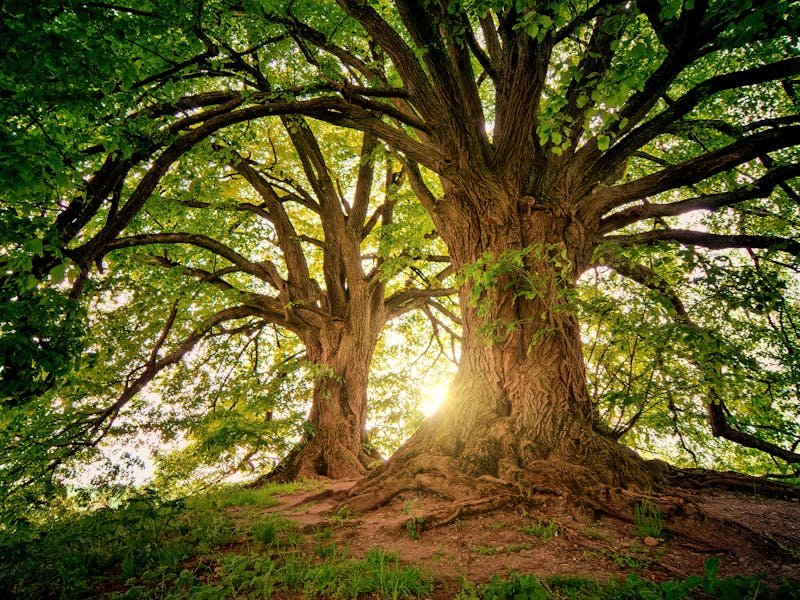
The mulch ring should extend out as far as practical from the trunk, ideally to the drip line (the outer edge of the canopy), though even a 4 to 6 foot radius around the trunk is helpful. The most important rule of mulching is to keep the mulch pulled back several inches from the trunk itself. The volcano mulching style, where mulch is piled up against the trunk in a mound, is one of the most common and most harmful landscaping mistakes we see in Huntsville. It traps moisture against the bark, promotes fungal growth, and can girdle the root flare over time. Your oak's trunk base should be visible, with the root flare exposed, not buried under a cone of mulch.
Fertilization
In most cases, established oaks in Huntsville do not need supplemental fertilization. Our native soils, while heavy with clay, contain adequate nutrients for oaks that have adapted to them over millennia. Over-fertilizing, especially with high-nitrogen fertilizers, can actually encourage excessive soft growth that is more susceptible to disease and insect damage.
There are exceptions. If a soil test indicates specific nutrient deficiencies, targeted supplementation can help. Oaks growing in heavily disturbed or compacted soil, such as construction fill, may benefit from soil amendments. And young oaks during establishment can be lightly fertilized in early spring to encourage root development. If you are unsure whether your oak needs fertilizer, get a soil test through the Alabama Cooperative Extension System office in Madison County. They will tell you exactly what your soil has and what it lacks.
When and How to Prune Oak Trees
Proper pruning is critical for oak health and safety, and improper pruning is one of the fastest ways to damage or even kill an otherwise healthy oak. Timing, technique, and knowing how much to take are all important.
The Right Time to Prune
In the Huntsville area, the ideal window for pruning oak trees is during the dormant season, from late November through the end of February. During dormancy, the tree is not actively growing, there is less stress from the removal of limbs, and most importantly, the insects that transmit oak wilt disease are inactive.
This timing issue is critical. The beetles (Nitidulidae family) that carry the oak wilt fungus are attracted to fresh wounds on oak trees and are most active from April through July. Pruning an oak during warm months creates open wounds that serve as an invitation for these beetles to land, feed, and potentially introduce the oak wilt pathogen directly into the tree's vascular system. It is essentially like performing surgery in a non-sterile environment.
If you absolutely must prune an oak during the growing season, say, because storm damage left a dangerous hanging limb that cannot wait until winter, the cut surfaces should be immediately sealed with a pruning wound paint. We know that wound paint has fallen out of favor for general use in arboriculture, and for good reason in most contexts. But oak wilt prevention is the one situation where sealing cuts is genuinely recommended by plant pathologists.
What to Prune
Routine pruning for oaks should focus on removing dead, dying, and diseased branches, eliminating crossing or rubbing limbs, maintaining clearance over structures and walkways, and thinning the canopy to improve air circulation and reduce wind resistance.
A good rule of thumb is to never remove more than 15 to 20 percent of a mature oak's live canopy in a single year. Oaks store significant energy reserves in their branches, and removing too much at once can stress the tree and trigger a decline. For young oaks, structural pruning to establish good branch architecture is important and can tolerate slightly more removal.
What Not to Do
Never top an oak tree. Topping, the practice of cutting main branches back to stubs, is one of the most destructive things you can do to any tree, but it is especially damaging to oaks. It removes a massive amount of the tree's energy-producing foliage, triggers a flush of weakly attached water sprouts, opens the tree to disease and decay, and permanently ruins its structural integrity. We have seen topped oaks in neighborhoods across South Huntsville and Madison that the homeowner paid someone to "trim," and the tree never recovered. Topping is not trimming. It is butchery. Any company that offers to top your oak tree is not a company you should be hiring.
Also avoid "lion-tailing," which is the removal of all interior branches, leaving foliage only at the tips. This concentrates weight at the ends of branches, increases the likelihood of limb failure, and removes the interior growth the tree needs for energy production.
Common Oak Diseases in the Huntsville Area
Oaks in North Alabama face several disease threats that every homeowner should be aware of. Early detection can sometimes save a tree, and at the very least, it can prevent the spread of disease to other oaks on your property or in your neighborhood.
Oak Wilt
Oak wilt is the most serious disease affecting oaks in the southeastern United States, and it has been confirmed in Alabama. It is caused by the fungus Ceratocystis fagacearum, which invades the tree's water-conducting vessels and essentially clogs the plumbing, causing the tree to wilt and die.
The symptoms of oak wilt vary depending on whether the affected tree is in the red oak group or the white oak group. Red oaks (Southern Red Oak, Water Oak, Willow Oak) are extremely susceptible and typically die within a few weeks to a few months of infection. Symptoms include rapid browning and wilting of leaves starting at the margins, leaves dropping while still partially green, and die-back progressing from the crown downward. A red oak with oak wilt can go from full canopy to dead in one season. It is devastating to watch.
White oaks are more resistant and decline more slowly, often over one to several years. Symptoms are similar but develop in a more patchy, branch-by-branch pattern rather than the whole-canopy crash seen in red oaks.
Oak wilt spreads in two ways: through root grafts between nearby oaks of the same species, and by the Nitidulid beetles that carry spores from diseased trees to wounds on healthy trees. This is why pruning timing matters so much. If you suspect oak wilt on your property, contact a certified arborist immediately. Containment measures, including trenching to sever root connections to neighboring oaks, may be needed to prevent spread.
Hypoxylon Canker
Hypoxylon canker is a fungal disease that we see frequently on oaks in the Huntsville area, particularly after drought stress. The fungus (Biscogniauxia atropunctata) is actually present in the sapwood of most healthy oaks all the time, living as an opportunistic endophyte. When the tree is healthy and vigorous, it keeps the fungus in check. But when the tree is weakened by drought, root damage, construction impact, or other stressors, the fungus takes over and colonizes the sapwood.
The telltale sign of hypoxylon canker is the appearance of a crusty, charcoal-like fungal mat on the trunk or major limbs, often after bark has sloughed away. Before the mat appears, the bark may blister and peel, exposing a grayish or brownish powdery fungal layer underneath. By the time you see the characteristic dark, crusty growth, the tree is usually too far gone to save.
We see hypoxylon canker most often on post oaks and red oaks that have been stressed by drought, especially on the drier ridges and hilltops around Monte Sano, Green Mountain, and the wooded properties along the bluff edge in McMullen Cove and The Ledges. The best prevention is maintaining tree health through proper watering during drought and avoiding root zone disturbance.
Bacterial Leaf Scorch
Bacterial leaf scorch (BLS) is caused by the bacterium Xylella fastidiosa, which is spread by leafhoppers and spittlebugs. It affects the water-conducting vessels in the leaves, causing them to scorch, or brown, from the margins inward. The scorching typically appears in late summer and progresses over several years, with the tree looking worse each season.
BLS is common on red oaks throughout the Southeast, and we see it regularly on oaks in the Huntsville area, particularly on Water Oaks and Southern Red Oaks in residential neighborhoods. There is no cure for BLS. Antibiotic trunk injections can suppress symptoms temporarily, but they are expensive and need to be repeated. In many cases, BLS-infected oaks slowly decline over 5 to 15 years and eventually need to be removed.
How Oak Trees Affect Property Values in Huntsville
Let's talk about the financial side of oaks, because it is significant and it often influences the decision about whether to keep or remove a tree. Mature oak trees are not just beautiful. They are valuable assets that directly impact your property's worth.
The Numbers
Multiple studies over the years have shown that mature, healthy trees can increase residential property values by 7 to 19 percent. For a $300,000 home in Huntsville, that translates to $21,000 to $57,000 in additional value attributable to the trees. A single large, healthy oak tree in a prominent location on a property has been estimated to add $10,000 to $30,000 to a home's appraised value, and in some cases even more.
In Huntsville neighborhoods where the mature tree canopy is a defining feature, the property value impact is especially pronounced. Homes in Blossomwood, Twickenham, Five Points, Old Town, and the Monte Sano area command premiums that are partly attributable to the established tree canopy, much of which consists of mature oaks. Real estate agents will tell you that the tree-lined streets in these neighborhoods are a major selling point.
The Flip Side
The flip side of that equation is that a dead, dying, or dangerous oak tree can hurt property values. A large oak that is clearly in decline, with dead branches, peeling bark, or a dangerous lean, sends a signal to potential buyers that they are looking at a significant tree removal expense in the near future. Some home inspectors and savvy buyers will flag hazardous trees as a negotiating point during the sale process.
This is why proactive management is so important. A healthy, well-maintained oak adds value. A neglected, declining one can become a liability. Regular pruning, disease monitoring, and timely action when problems develop protect both the tree and your investment.
When an Oak Tree Needs to Come Down
This is the section nobody wants to read, but it is the most important one for your safety and your property. Oaks are magnificent trees and we understand the emotional attachment homeowners develop toward them. We have had homeowners in tears telling us about the oak they grew up climbing, the one their parents planted when they built the house, the one that has been there since before the neighborhood existed. We get it. And we do everything we can to save a tree when saving it is a reasonable option.
But sometimes removal is the only responsible choice. Here are the situations where we recommend taking an oak down:
Advanced Decay
If the trunk has large cavities, if mushrooms are fruiting at the base, if the wood is soft and punky when you probe it, the tree's structural integrity is compromised. An oak with advanced trunk or root decay can fail catastrophically without warning. We use tools like resistographs to measure the amount of sound wood remaining in a trunk, and if the numbers say the tree does not have enough solid wood to support itself, it needs to come down regardless of how the canopy looks.
Significant Root Failure
Oaks with severed, decayed, or girdling roots lose their anchorage in the soil. This is especially dangerous in Huntsville's clay soils, which can become saturated and slippery during heavy rain events. A large oak that uproots can cause catastrophic damage to anything in its fall path. Signs of root failure include soil heaving, a new lean, and visible root decay or damage at the base of the tree.
Oak Wilt Infection in Red Oaks
Once a red oak (Southern Red Oak, Water Oak, Willow Oak) is confirmed infected with oak wilt, there is no saving it. The tree will die, typically within weeks to months. Prompt removal is important to prevent the spread of the disease to other oaks on the property and in the neighborhood, particularly through root grafts.
Structural Defects That Cannot Be Corrected
Large, included bark crotches that split the trunk, cracks that extend through the main stem, multiple competing leaders that create a structurally unstable form: these are defects that cabling, bracing, and pruning cannot adequately address. If the tree is near a target, meaning it could hit your house, your car, or an area where people spend time, the risk is too great to leave it standing.
Water Oaks Past Their Prime
This deserves its own mention because it is so common in the Huntsville area. Water Oaks planted in the 1950s through the 1980s are now 40 to 70 years old, which puts them in the second half of their natural lifespan. If a Water Oak on your property is showing signs of decline, large dead branches, bark loss, fungal growth, increasing limb drop, it is probably not worth trying to extend its life. The cost of repeated treatments, pruning, and emergency cleanup typically exceeds the cost of removing it and planting a longer-lived replacement.
We have had this conversation with dozens of homeowners in neighborhoods throughout Weatherly Heights, Jones Valley, Research Park, and the older parts of South Huntsville. The Water Oaks that were planted when those neighborhoods were developed are reaching the end of their run. It is not a failure of care. It is just the biology of the species. Planning a proactive, controlled removal is far better than dealing with an emergency failure during storm season.
Planting New Oak Trees: Getting It Right
If you are thinking about adding an oak to your property, or replacing one that has been removed, here are our recommendations for the Huntsville area:
Choose the right species for your site. White Oaks and Southern Red Oaks are the best all-around choices for most Huntsville properties. They are long-lived, strong, beautiful, and well-adapted to our conditions. Avoid Water Oaks for new plantings. Their short lifespan makes them a poor long-term investment.
Give it room. A mature oak needs space, lots of it. Plant large species at least 20 to 25 feet from your house and 15 to 20 feet from driveways, sidewalks, and utility lines. The tree might look small and lonely in its spot today, but in 30 years you will be glad you gave it room to grow.
Plant it right. Dig the hole two to three times wider than the root ball but no deeper. The root flare, where the trunk widens at the base, should be visible at or slightly above the soil surface. Planting too deep is one of the most common reasons young trees fail in Huntsville's heavy clay soil, because it promotes root rot and girdling roots.
Mulch and water. Apply a 3-inch ring of mulch over the root zone, keeping it away from the trunk. Water deeply once a week during the first two growing seasons, more frequently during drought. After establishment, the tree should be largely self-sufficient.
Frequently Asked Questions
What types of oak trees grow in Huntsville, Alabama?
The most common oak species in the Huntsville area are Southern Red Oak, White Oak, Water Oak, Post Oak, and Willow Oak. You will also find Overcup Oak in wetter, low-lying areas and Chinkapin Oak on rocky limestone outcrops. Each has different characteristics, growth rates, and lifespans. Southern Red Oaks and White Oaks are the most valued for their size, beauty, and longevity. Water Oaks, while common, have the shortest lifespan at only 50 to 80 years.
When is the best time to prune oak trees in Alabama?
Prune oaks during the dormant season, from late November through February. This timing minimizes stress on the tree and avoids the warm-weather activity period of the beetles that spread oak wilt disease (April through July). If storm damage requires emergency pruning during warm months, seal all cuts immediately with wound paint to prevent beetle access. Never remove more than 15 to 20 percent of a mature oak's canopy in a single year.
What are the signs of oak wilt disease?
Oak wilt symptoms include rapid leaf browning starting at the margins, leaves dropping while still partially green, die-back progressing from the crown downward, and discolored sapwood under the bark. Red oaks die within weeks to months of infection, while white oaks decline more slowly over years. If you notice sudden, widespread leaf wilting on an oak during the growing season, contact a certified arborist immediately for evaluation. Early detection can help contain the spread to neighboring trees.
How much does it cost to remove a large oak tree in Huntsville?
Large oak tree removal in Huntsville typically costs $1,200 to $3,500 or more depending on the tree's size, location, and job complexity. A 60-foot oak in an open area is less expensive than one growing near a house, fence, or power lines. Costs include felling, limbing, trunk sectioning, and cleanup. Stump grinding is usually an additional $150 to $400. We provide free estimates so you know exactly what to expect before any work begins.
Do oak trees increase property value?
Absolutely. Studies consistently show that mature, healthy trees add 7 to 19 percent to residential property values. In Huntsville neighborhoods known for their tree canopy, like Blossomwood, Twickenham, and Monte Sano, mature oaks are a significant contributor to home values. A single large, healthy oak can add $10,000 to $30,000 or more to a property's appraisal. However, a dead or hazardous oak can hurt values, making proactive care and timely removal of declining trees equally important.
How long do oak trees live in Alabama?
Lifespan varies dramatically by species. White Oaks are the longest-lived, commonly reaching 300 to 600 years. Southern Red Oaks typically live 150 to 300 years. Post Oaks can reach 300 to 400 years. Water Oaks, on the other hand, only live 50 to 80 years, which is why many Water Oaks planted in Huntsville neighborhoods during the mid-twentieth century are now declining and requiring removal. When choosing an oak to plant, species selection makes a huge difference in how long the tree will serve your property.