Let's talk about something that seems incredibly simple but that we see done wrong on probably 80 percent of the properties we visit across the Huntsville area: mulching. It sounds like the most basic thing in the world. You put some mulch around a tree. How hard can it be?
Well, it turns out there's a right way and a very wrong way, and the wrong way is so popular in North Alabama that we've basically made it our mission to spread the word about proper mulching technique every chance we get. If you've driven through any commercial property, subdivision entrance, or even some of the nicest neighborhoods in Madison, Hampton Cove, or Bailey Cove lately, you've probably noticed what we in the tree industry call "mulch volcanoes" - those tall, cone-shaped piles of mulch heaped up against tree trunks like little mountains. They're everywhere. And they're slowly killing the trees they're supposed to be helping.
We're going to cover everything about mulching in this guide: why it matters (especially in our Alabama climate), how to do it correctly, what type of mulch to use, when to apply it, how deep to go, and all the common mistakes that turn a beneficial practice into a harmful one. If you've got trees on your property, whether they're brand new plantings or 50-year-old oaks, this information applies to you.
Why Mulching Matters So Much in Huntsville's Climate
Before we get into the how-to, let's talk about why mulching is particularly important for trees in the Huntsville, Alabama area. Our climate and soil conditions create a set of challenges that mulch directly addresses.
Moisture retention during brutal summers. Huntsville summers are hot. We're talking weeks of 90-plus degree days, often with high humidity that makes it feel even worse. While that humidity puts moisture in the air, it doesn't necessarily keep the soil moist, especially during those dry stretches we get in July and August when it might not rain meaningfully for two or three weeks. Our heavy red clay soil makes this worse because when it dries out, it shrinks and cracks, pulling away from root systems and leaving air gaps that dry out fine feeder roots. A proper layer of mulch significantly reduces moisture evaporation from the soil surface, keeping the root zone more consistently moist and reducing the stress on your trees during the toughest part of summer.
Soil temperature regulation. Our clay soil can reach surface temperatures of 130 degrees or more in direct sunlight during an Alabama summer. That's hot enough to damage or kill the fine roots that grow in the top few inches of soil, which is where most nutrient and water absorption happens. Mulch insulates the soil, keeping summer temperatures 10 to 20 degrees cooler and winter temperatures warmer. This creates a more stable environment for root growth year-round.
Clay soil improvement. Here's something a lot of homeowners don't realize: organic mulch slowly breaks down and incorporates into the soil beneath it. Over time, years of mulch decomposition transforms the top layer of hard, compacted clay into softer, more fertile soil with better structure and drainage. This is how forest floors work in nature. The leaf litter and organic debris that accumulates under trees decomposes and creates the rich, dark, crumbly topsoil that tree roots thrive in. When we clear-cut lots for development and strip away that organic layer, mulching is the best way to start rebuilding it.
Weed suppression. A proper mulch layer suppresses weed growth around trees, which eliminates the need for mowing or string trimming close to trunks. This is more important than it sounds. We see a shocking amount of tree damage from mowers and weed eaters across Huntsville properties. That scar on the base of the trunk where the bark has been knocked off by a string trimmer? That's an open wound that allows insects and disease to enter the tree. A mulch ring eliminates the need to mow close to the trunk and protects the tree from mechanical damage.
Root protection from compaction. In neighborhoods throughout Huntsville and Madison, foot traffic, mowing, and general yard activity compact the soil over tree root zones. Compacted clay soil is nearly impermeable to water and air, which suffocates roots. A layer of mulch cushions the soil surface and reduces compaction from normal activity.
The Mulch Volcano Problem: The Biggest Mistake Homeowners Make
We need to spend some time on this because it's genuinely one of the most common and damaging tree care mistakes in our area. Drive through any neighborhood in Research Park, Jones Valley, Town Madison, or Owens Cross Roads and you'll see them: mulch piled up against tree trunks in tall, cone-shaped mounds. Sometimes it's 6 inches deep against the bark. Sometimes it's a foot or more. We've seen mulch volcanoes in South Huntsville that were taller than a toddler.
Landscape companies do it. Homeowners do it. HOA-mandated landscape crews do it. Commercial property maintenance crews do it. And every year, they pile more on top of what's already there, building the volcano higher and higher. It looks neat. It looks tidy. It looks intentional. And it is absolutely devastating to the trees.
Here's what a mulch volcano does to a tree:
Bark rot. Tree bark is designed to be exposed to air and light. It's the tree's armor, protecting the living tissue underneath from pathogens, insects, and environmental stress. When you pile mulch against the bark, you create a constantly moist environment against tissue that's not adapted to being wet. The bark softens, begins to decompose, and pathogens move in. We've peeled back mulch volcanoes on trees in the Athens and Decatur area and found the bark underneath literally rotting away, soft and spongy, with the cambium (the living growth layer) already compromised.
Circling and girdling roots. When mulch is piled deep against the trunk, the tree sometimes responds by growing roots up into the mulch rather than outward into the soil. These roots grow in circles around the trunk, and over time they tighten like a noose, literally strangling the tree by cutting off the flow of water and nutrients through the trunk. We call these girdling roots, and they're one of the most common causes of slow, mysterious tree decline in Huntsville neighborhoods. The tree looks fine for years, then gradually starts thinning, dropping branches, and declining. You pull back the mulch and there's a root wrapped around the trunk, choking the life out of it.
Rodent habitat. Deep mulch piled against a trunk creates a cozy, sheltered environment for mice and voles. These rodents nest in the mulch and then gnaw on the bark underneath, hidden from view. We've found trees where rodents had chewed a complete ring around the trunk under the mulch, killing the tree by girdling it. The homeowner had no idea until the tree failed to leaf out the following spring.
Hidden problems. A thick pile of mulch against the trunk hides everything. Fungal growth, insect infestations, bark damage, cankers, all of it is concealed beneath the mulch. You can't monitor what you can't see, and by the time symptoms show up in the canopy, the damage at the base may be too far gone to address.
The right way: Think donut, not volcano. Mulch should be applied in a flat ring around the tree, 2 to 4 inches deep, extending out as far as practical (ideally to the drip line, but at minimum 3 to 4 feet from the trunk). And here's the critical part: pull the mulch back 3 to 4 inches from the trunk itself. You should be able to see the root flare, that slight widening where the trunk meets the ground. If you can't see the flare, there's too much mulch (or soil) piled against the trunk.
Best Types of Mulch for Trees in North Alabama
Not all mulch is created equal. Here's a breakdown of the options available to Huntsville homeowners, from best to worst.
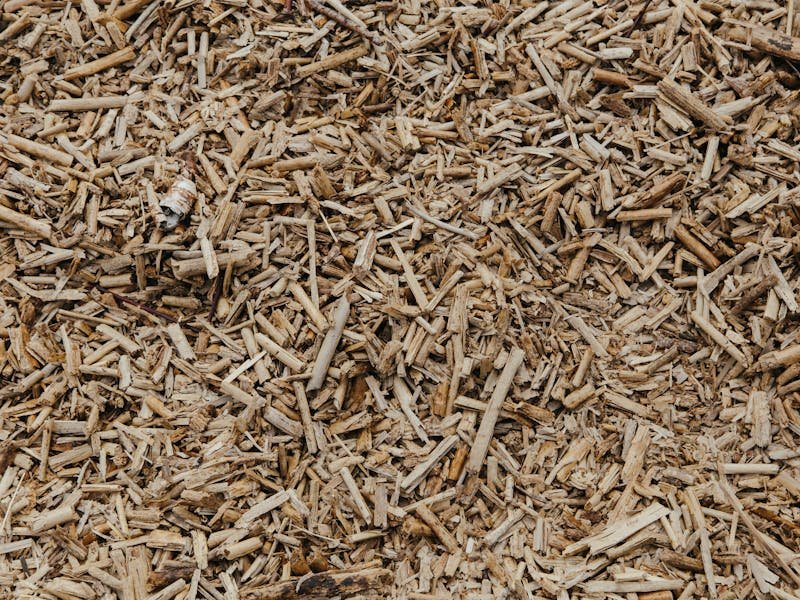
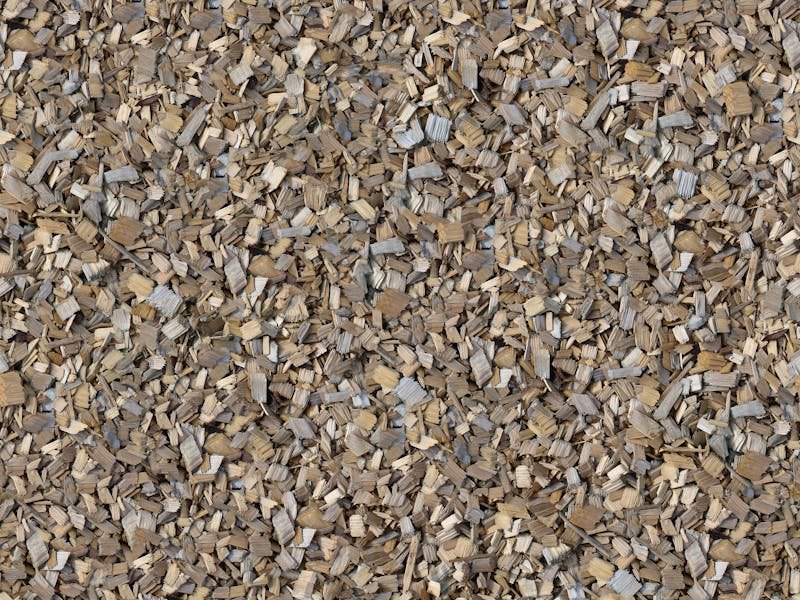
Fresh wood chips from a tree service (Best value). When our crew trims or removes trees, the branches go through a chipper and come out as fresh wood chips. This is some of the best mulch available, and it's often free or available at very low cost because tree services need somewhere to put it. Fresh wood chips are a mix of wood, bark, and leaves that provides excellent moisture retention, slow nutrient release, and long-lasting coverage. They're coarser than bagged mulch, which actually helps prevent matting and compaction. Don't worry about the old myth that fresh wood chips "rob nitrogen from the soil." Research from multiple university extension programs has shown this effect is negligible and limited to the very top layer of soil where the chips contact the ground.
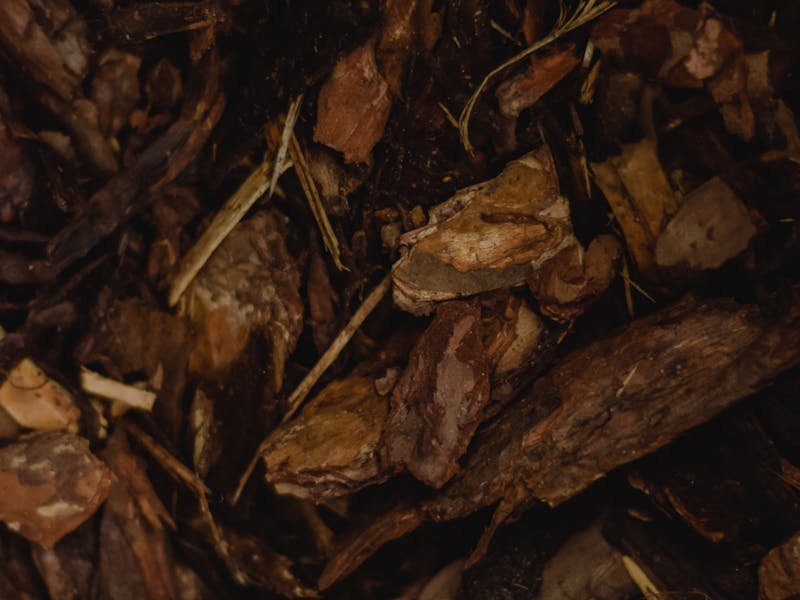
Hardwood bark mulch (Best appearance). This is the standard bagged or bulk mulch available at garden centers and supply yards across Huntsville. It's made from the bark of hardwood trees, primarily oak and hickory in our area. Hardwood bark decomposes relatively slowly, lasting 1 to 2 years before it needs to be refreshed, and it improves soil quality as it breaks down. It has a natural brown color that looks attractive in landscape beds. Go for the double or triple-shredded variety, which knits together nicely and stays put during heavy rain.
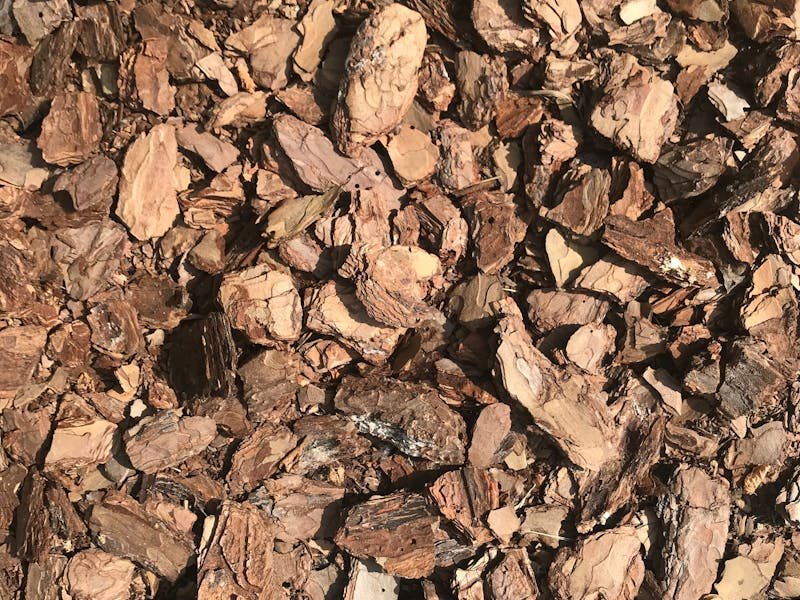
Pine bark mulch and pine straw (Good for acid-loving plants). Pine bark nuggets and pine straw are widely available in North Alabama and work well around acid-loving trees and shrubs. Pine straw is the most commonly used mulch in our area, particularly in the more rural neighborhoods and around Meridianville, Harvest, and Moores Mill. It's relatively inexpensive, easy to apply, and looks good in a natural setting. However, pine straw decomposes faster than hardwood mulch and needs to be replenished more frequently, typically twice a year.
Composted mulch (Best for soil improvement). Composted mulch is partially decomposed organic matter that's further along in the breakdown process than fresh mulch. It provides less weed suppression and moisture retention than fresh mulch but contributes more immediately to soil fertility. It's a good option to mix with coarser mulch or to use on trees planted in particularly poor, compacted clay.
Types to avoid:
- Dyed mulch (red, black, orange): The dye is cosmetic and adds nothing beneficial. Worse, dyed mulch is often made from ground-up pallets, construction waste, and other recycled wood that may contain chemicals, nails, or treated lumber. We've seen dyed mulch from big box stores that had visible chunks of painted wood in it.
- Rubber mulch: Does not decompose, does not improve soil, gets extremely hot in summer sun (surface temperatures can exceed 160 degrees), and leaches chemicals into the soil. It's terrible for trees. Don't use it.
- Cypress mulch: The harvest of Cypress trees for mulch is contributing to the destruction of Southern wetland forests. Environmentally, it's one of the worst choices. Use hardwood bark or wood chips instead.
- Rock or gravel: Rocks don't decompose, don't improve soil, and they absorb and radiate heat, cooking roots in summer. Not recommended around trees.
How to Mulch a Tree Correctly: Step by Step
Here's the process we recommend for mulching trees on Huntsville properties. Whether you're mulching a brand new tree you just planted or refreshing the mulch around a 40-year-old oak, the basic technique is the same.
Step 1: Clear the area. Remove any existing weeds, grass, or debris from the area you're going to mulch. If there's old, matted mulch already there, rake it up to break it apart. You don't have to remove old mulch entirely if there's less than 2 inches remaining, but you need to fluff it up so water and air can penetrate.
Step 2: Define your mulch ring. For a new tree, the mulch ring should extend at least 3 to 4 feet out from the trunk in all directions. For established trees, go wider if practical. The wider the mulch ring, the more roots you're protecting and the more soil improvement you're getting. Ideally, the mulch ring extends to the drip line of the canopy, but we know that's not always practical. Even a 6-foot diameter ring is dramatically better than nothing.
Step 3: Apply mulch to the correct depth. Spread mulch evenly within the ring at a depth of 2 to 4 inches. On our Huntsville clay soil, 3 to 4 inches is the sweet spot because the moisture retention benefit is particularly valuable. Use a ruler or just your hand to check the depth. It should be roughly to the second knuckle of your hand spread flat.
Step 4: Pull mulch away from the trunk. This is the most important step. Rake the mulch back from the trunk, leaving a 3 to 4 inch gap of bare soil between the mulch and the bark. You should be able to see the root flare, where the trunk widens slightly as it meets the ground. If the root flare is buried, carefully remove soil and mulch from around the base until you can see it. We find buried root flares on probably a third of the trees we assess in Huntsville. It's that common, and it's that harmful.
Step 5: Water the mulch. After applying, give the mulched area a thorough soaking. This helps settle the mulch into place and begins the process of moisture absorption. It also helps prevent light, dry mulch from blowing away in wind.
Mulching New Trees vs. Established Trees
While the basic technique is the same, there are some differences worth noting when mulching newly planted trees versus established ones.
Newly planted trees: Mulching is absolutely critical for new trees, especially in Huntsville's climate. A new tree has a small, limited root system confined to the original root ball, and it's totally dependent on the soil immediately around it for water and nutrients. Mulch keeps that critical zone moist and temperature-stable. For new trees, apply 3 to 4 inches of mulch in a ring that extends at least 3 feet beyond the root ball in all directions. Do not pile mulch against the trunk. New trees in clay soil are especially vulnerable to both drought stress and waterlogging, and mulch helps buffer against both extremes.
New plantings in neighborhoods like The Ledges, McMullen Cove, Wade Mountain, and the newer subdivisions in Clift Farm and Town Madison are planted into some of the toughest clay on earth. We've seen newly planted trees fail within a single growing season because they weren't mulched and the clay baked hard in July, shrinking away from the root ball and leaving the roots hanging in an air gap. Mulch prevents that.
Established trees: Older, established trees benefit from mulching too, though they're less dependent on it for survival. For large trees, extend the mulch ring as far out as practical. Even mulching a 10-foot diameter circle around a big oak makes a meaningful difference in root health and soil quality. If you've got a large tree in your yard that's been surrounded by mowed turf its whole life, converting that area under the canopy to a mulch bed is one of the best things you can do for the tree's long-term health.
We see a lot of established trees in Five Points, Twickenham, Blossomwood, and Old Town that are declining slowly, and in many cases the cause is compacted, degraded soil around the root zone combined with decades of mowing right up to the trunk. Converting even a portion of the area under the canopy to a mulched bed, with no mowing or foot traffic, can significantly improve the tree's health over a few growing seasons.
When to Mulch Trees in Huntsville, Alabama
Mulching can be done any time of year, but two windows are ideal for our area.
Early spring (March through April): Applying mulch in spring prepares your trees for the summer ahead. The mulch layer traps winter and spring moisture in the soil, giving trees a reserve to draw from when the dry summer heat arrives. Spring mulching also suppresses the flush of spring weed growth that competes with trees for water and nutrients.
Mid-fall (October through November): Fall mulching insulates root zones heading into winter. While Huntsville winters are mild compared to the north, we do get cold snaps and occasional hard freezes. A good mulch layer moderates soil temperature fluctuations and protects roots from freeze-thaw cycles. Fall mulching also gets the organic decomposition process started during the cool, moist months, enriching the soil for the following growing season.
How often to refresh: Plan to check your mulch depth in spring and fall. Organic mulch breaks down over time, which is a good thing for the soil but means the layer gets thinner. If it's dropped below 2 inches, add more to bring it back to the 3 to 4 inch range. Most mulch needs refreshing once or twice a year. Pine straw breaks down faster and may need refreshing every 4 to 6 months.
Common Mulching Mistakes Beyond the Volcano
Besides the mulch volcano, here are other common mulching mistakes we see on Huntsville properties.
Too-small mulch rings. A tiny circle of mulch right around the base of the tree, maybe 2 feet in diameter, is better than nothing but provides minimal benefit. Tree roots extend far beyond the trunk, often out past the drip line of the canopy. A wider mulch ring means more root protection. We understand that nobody wants to mulch their entire yard, but make the ring as wide as aesthetics and budget allow.
Mulch over landscape fabric. Some homeowners lay landscape fabric under their mulch, thinking it will provide better weed control. Don't do this around trees. Landscape fabric blocks the organic mulch from incorporating into the soil, defeating one of mulching's primary benefits. It also prevents air and water from reaching roots effectively. Tree roots can grow into and through landscape fabric, creating a tangled mess that's nearly impossible to remove. Use mulch alone for weed control.
Not removing old matted mulch. Over time, some mulches, especially fine-textured ones, can develop a matted, almost waterproof layer on the surface. When this happens, water runs off the mulch rather than soaking through to the soil. Before adding new mulch, always rake through the existing layer to break up any matting and restore porosity.
Using too much at once. If your existing mulch has decomposed down to nothing, resist the urge to dump 8 inches of new mulch to "catch up." Too-deep mulch smothers roots just as effectively as compacted soil. Build it up to 3 to 4 inches and stop.
Ignoring mulch around street trees. The trees in the strip between the sidewalk and the street (the "tree lawn") are often the most stressed trees on a property. They're in compacted soil, surrounded by pavement, and hit by road salt in winter. A mulch ring around these trees is incredibly beneficial but rarely done. If your neighborhood has planting strips, mulching those trees helps the entire streetscape.
Getting Free or Cheap Wood Chip Mulch
One of the best things about being in a city with lots of trees is that there's a constant supply of free mulch available. When tree service companies like ours trim trees and remove trees across the Huntsville metro area, we generate truckloads of wood chips every day. Often, we're looking for places to dump those chips, and homeowners who are willing to take a load can get excellent mulch for free or at minimal delivery cost.
Here are a few ways to get free or cheap wood chip mulch in the Huntsville area:
- Ask your tree service: When you have us out for trimming or removal, ask if we can leave the wood chips. Most of the time, we're happy to do so because it saves us a trip to the disposal site. The chips will be fresh and may include a mix of species, which is perfectly fine for mulching.
- Check community programs: The City of Huntsville and Madison County occasionally offer free mulch from their yard waste composting programs. Check with the Solid Waste Disposal Authority for availability.
- Buy in bulk: If you need a large quantity, buying mulch by the cubic yard from a local landscape supply yard is much more economical than buying it by the bag. A cubic yard of mulch costs roughly $25 to $45, and one cubic yard covers approximately 100 square feet at 3 inches deep. Compare that to $4 to $6 per 2-cubic-foot bag at the big box stores, where you need 13 to 14 bags to equal one cubic yard.
Mulching is one of those things that's simple, inexpensive, and makes a huge difference in the health and longevity of your trees. It's especially critical here in Huntsville where our clay soil, hot summers, and severe weather create constant challenges for tree root systems. If you do nothing else for your trees this year, mulch them. Do it right, no volcanos, and your trees will thank you with better health, faster growth, and more resilience against the storms that we know are coming.
Need help with mulching, tree trimming, or any other tree care service? Give Huntsville Tree Pros a call at (256) 555-0123 or request a free estimate online. We serve Huntsville, Madison, Decatur, Athens, and all surrounding communities.
Frequently Asked Questions
How deep should mulch be around trees?
The ideal mulch depth around trees is 2 to 4 inches. More than 4 inches can smother roots, trap excess moisture, and create conditions for disease. Less than 2 inches provides minimal benefit. Keep mulch pulled back 3 to 4 inches from the trunk to prevent moisture buildup against the bark, which can cause rot and invite pests.
What is a mulch volcano and why is it bad for trees?
A mulch volcano is a cone-shaped pile of mulch heaped up against a tree trunk, sometimes 12 inches deep or more. This is one of the most harmful things you can do to a tree. It traps moisture against the bark causing rot, encourages the growth of circling roots that can girdle and kill the tree, creates a habitat for rodents that gnaw on bark, and hides signs of disease and pest problems. Mulch should be spread in a flat ring, like a donut, not piled up against the trunk.
What is the best type of mulch for trees in Alabama?
For trees in North Alabama, hardwood bark mulch and fresh wood chips from a tree service are the two best options. Hardwood bark mulch decomposes slowly and improves our clay soil over time. Fresh wood chips from a tree service are often free or very inexpensive and provide excellent moisture retention and weed suppression. Avoid dyed mulch, rubber mulch, and cypress mulch.
When is the best time to mulch trees in Huntsville, Alabama?
The best times to mulch trees in Huntsville are early spring (March to April) before summer heat arrives and mid-fall (October to November) to insulate roots through winter. Spring mulching is particularly important in our area because it helps retain moisture during the hot, dry periods of July and August. Mulch can be applied any time of year, but these two windows provide the most benefit.
How much does professional tree mulching cost in Huntsville?
Professional mulching in the Huntsville area typically costs $50 to $200 per tree depending on the size of the mulch ring and the type of mulch used. Many tree service companies offer mulching as an add-on when they're already on your property for tree trimming or removal. Wood chips from tree service work are often available for free or at minimal cost and make excellent mulch.
Should I remove old mulch before adding new mulch?
You don't necessarily need to remove old mulch before adding new, but check the total depth first. If the existing mulch layer has decomposed down to 1 inch or less, you can add new mulch on top to bring the total back to 3 to 4 inches. If there are still 2 or more inches of old mulch, rake it up to break apart any matted layers and add only enough new mulch to reach the 3 to 4 inch total depth. Never pile new mulch on top of deep old mulch.