
A woman in Five Points called me last fall with a story I have heard maybe a hundred times. Her toilet had been gurgling for about three weeks. She figured it was nothing. Then one Saturday morning she ran a load of laundry, went to take a shower, and watched the tub fill up with dirty water from the washing machine. By the time she called a plumber, the sewer line was completely blocked and the bill for the emergency snake job was 425 dollars. Two months later, the line backed up again.
By the time she called us, she had spent more than 1,100 dollars on plumbers in six months and nobody had told her what was actually happening. The answer, like it is for most of these situations, was tree roots. Specifically, a sweetgum sitting about 12 feet from her sewer line that had been quietly sending roots into a cracked joint for probably 15 years.
I am not a plumber. I am a tree guy. But I have been pulling trees off sewer lines and talking to plumbers about these jobs long enough that I want to walk through the whole picture for Huntsville homeowners. Because this is one of those problems where understanding the tree side of the equation is what saves you thousands of dollars down the road.
How tree roots actually get into sewer lines
There is a myth that roots bust through the walls of sewer pipes like some kind of horror movie. That is not really what happens. Roots are opportunistic. They follow water and nutrients. They do not have the force to punch through a solid, intact pipe.
What they do is find weaknesses that are already there. And in Huntsville, older homes are full of those weaknesses.
If your house was built before 1980, there is a reasonable chance your sewer lateral (the pipe running from your house to the city main) is made of vitrified clay or cast iron. Clay pipes come in sections about two to three feet long, joined with what was originally a rope and tar seal. Over 50, 60, 70 years, those seals fail and the joints develop tiny gaps. Groundwater seeps in, and water vapor seeps out.
Roots sense that moisture. A hair-thin root finds its way into the joint, slides inside the pipe, and suddenly it is in nutrient paradise. Warm, wet, full of organic material. Within a few years, what started as a thread is a woven mat filling the inside of the pipe.
PVC pipe, which became standard in the 1980s, is much more resistant because it comes in longer sections with glued joints. But even PVC can develop cracks from shifting soil, and roots will exploit those just as readily. Orangeburg pipe, a tar-paper material used briefly in the 1950s and 1960s, is even worse than clay.
Warning signs you probably have root intrusion
The signs build slowly. That is why so many homeowners end up paying for emergency plumbing calls instead of catching the problem early. Here is what to watch for.
Slow drains are usually the first hint. Not one slow drain (that is probably a local clog) but multiple drains slowing down at the same time. Your shower drains a little slower, the kitchen sink is taking longer, the washing machine cycle backs up briefly. When the problem is in the main line rather than a branch, it affects everything connected to that line.
Gurgling sounds are another early indicator. When you flush a toilet and hear a weird glug coming from the tub drain, that is air getting pushed past a partial blockage. Same with running the washing machine and hearing the toilet bowl bubble.
Frequent backups are the obvious symptom. If you have had a plumber snake your line more than once in the past two years, roots are a strong suspect. A one-time clog can happen to anyone. Repeat clogs in the same spot mean something is wrong with the pipe itself.
A sewer smell in or around your house is worth paying attention to. If you walk outside and smell sewage near a particular spot in your yard, or if a room has a faint rotten-egg smell that will not go away, you may have a crack in the line that is leaking. Roots usually accompany those cracks.
Unusually green, lush patches of grass in your yard are a sneaky sign. If one strip of your lawn is noticeably greener than the rest, especially running in a line from your house toward the street, that is your sewer line fertilizing itself through a leak. Small sinkholes or soft spots can also appear as soil washes into a broken pipe. By the time you see a sinkhole, the pipe is significantly damaged.
The Huntsville trees that cause the most problems
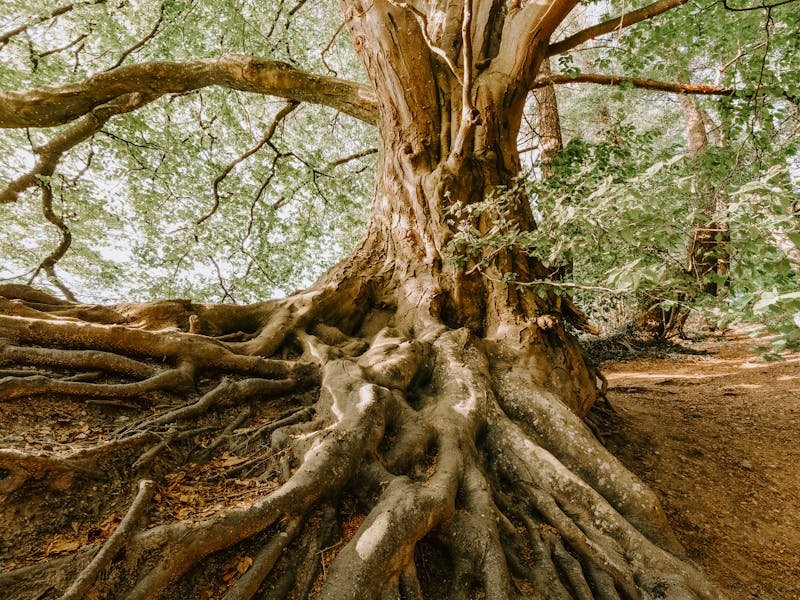
Not every tree is a sewer line threat. Some species send out aggressive, water-seeking, shallow root systems that cause the majority of root intrusion cases. Here are the ones I see over and over in North Alabama.
Silver maples are maybe the worst offender. They grow fast, they get enormous, and their roots are aggressive and shallow. A mature silver maple can send roots 60 or 70 feet from the trunk. If you have one anywhere near your sewer line, it is probably already interacting with it.
Sweetgums are a close second. They are everywhere in Huntsville, they have strong lateral root systems, and they seem to have a talent for finding cracked pipes. The woman in Five Points I mentioned at the start had a sweetgum. Willows are the classic sewer-line killer. If there is a water leak within 100 feet, a willow will find it.
Poplars, especially tulip poplars, are widespread around Huntsville and Monte Sano. They grow fast, their roots are aggressive, and mature specimens routinely cause sewer issues. Bradford pears are a nightmare for multiple reasons (they split in storms, they are invasive, they stink when they bloom), and their root systems are also aggressive.
Water oaks and pin oaks round out the list. They are not quite as aggressive as the species above, but they grow big and their roots will still exploit any cracked pipe they find. We have covered more about how oak and maple roots interact with structures in our post on tree root damage to foundations in Huntsville.
Confirming it is actually roots
Before you spend serious money on repairs, you need to know what you are dealing with. Plenty of sewer backups are caused by grease, flushed wipes, collapsed pipe sections, or blockages that have nothing to do with trees. Guessing wrong is expensive.
The right first step is a sewer camera inspection. A plumber runs a waterproof camera on a long cable down the cleanout and through your sewer line, and you watch a screen in real time. Roots look unmistakable, a feathery mass sometimes completely filling the pipe, sometimes just a ribbon across the top. A broken pipe section looks different. A collapsed Orangeburg pipe looks different still.
Camera inspections in Huntsville typically run 150 to 350 dollars as a standalone service, though many plumbers include them free when you pay for a snake job. Do not skip this step. I have seen homeowners spend 8,000 dollars on a pipe replacement when a 600-dollar hydro-jet would have solved the problem, and I have seen the opposite too. Without a camera, you are guessing.
Your options once you confirm root intrusion
Once you know roots are the problem, you have a range of options that trade off cost against how long the fix lasts.
Mechanical snaking with a rooter-style cutting head is the cheapest option, running about 150 to 400 dollars. It cuts a hole through the root mass and restores flow. The downside is that it leaves the root structure in the pipe. New growth starts immediately, and you will likely be back in the same spot within 12 to 24 months.
Hydro-jetting uses high-pressure water (typically 3,500 to 4,000 PSI) to scour the inside of the pipe, cutting out roots more thoroughly than a mechanical auger. It usually runs 400 to 900 dollars. A good hydro-jet job can buy you two to four years before roots return, assuming the tree is still there.
Foaming root killer is a chemical treatment, usually based on copper sulfate or a metam-sodium compound. You pour it down the toilet or a cleanout, and it coats the inside of the pipe and kills root tissue on contact. These products run 30 to 80 dollars and can extend the time between mechanical cleanings. They do not fix the pipe permanently, but they are a useful maintenance tool.
Trenchless pipe lining (also called cured-in-place pipe or CIPP) is a more permanent fix. A plumber inserts a flexible liner coated in epoxy resin into the existing pipe, inflates it, and cures it in place. You end up with a new pipe inside the old one. It costs 80 to 250 dollars per foot, so a 40-foot run can easily hit 6,000 dollars, but it lasts 50 years and does not require digging up your yard.
Full dig-and-replace is the traditional approach. You excavate the line from house to street, remove the old pipe, install new PVC, and backfill. In Huntsville, this runs 5,000 to 15,000 dollars depending on depth, length, landscaping, and whether driveways or sidewalks have to be cut and replaced.
When tree removal is the only answer that lasts
Here is where my world and the plumber's world overlap, and where homeowners sometimes get bad advice from both sides. A plumber who does not deal with trees may tell you the pipe repair is all you need. A tree service that does not understand plumbing may tell you the tree has to come down when it really does not.
You should seriously consider tree removal when the tree is within 10 feet of the sewer line and is one of the aggressive species I listed above. At that distance, even a brand-new PVC pipe is at risk over the long term. Also consider removal when you have had repeat root intrusion in the same spot despite snaking or jetting the line. If roots keep coming back within a year or two, you are fighting a battle you cannot win by clearing the pipe alone.
If the tree is already in poor health, getting ahead of the sewer problem is a bonus reason to take it down now rather than in three years. And if you have 60-year-old clay pipe and a mature silver maple within 15 feet, you are going to be paying for root work the rest of the time you own the house. At some point the math stops working.
On the other hand, if the tree is a healthy specimen you value and the line is at the outer edge of its root zone, pipe lining combined with annual root killer treatments can keep things under control for years. Not every root problem requires a chainsaw.
When removal is the right call, we handle it start to finish. Our tree removal service includes stump grinding, which matters because a ground stump will continue to send up sucker growth and can keep pushing roots for a year or two. If you are replacing the sewer line at the same time, coordinate the tree removal first so the plumber can trench without working around the stump.
What this realistically costs a Huntsville homeowner
Let me put some real numbers together, because the mix of potential expenses is where people get overwhelmed.
On the low end, if you catch the problem early and just need a one-time snake, you are looking at 150 to 400 dollars. Combine that with a 60-dollar bottle of foaming root killer used twice a year and you might hold the problem off for a while.
A more realistic moderate scenario is to hydro-jet the line, do a camera inspection, apply root killer quarterly. That is 500 to 1,100 dollars in year one, then maybe 200 dollars a year in maintenance. If you go the trenchless lining route, plan on 4,000 to 8,000 dollars for a typical residential run in Huntsville. Full dig-and-replace sits at 5,000 to 15,000 dollars, and if the line runs under a driveway or mature landscaping, add another 1,500 to 4,000 dollars for restoration work.
Tree removal, if that ends up being part of the solution, ranges from about 600 dollars for a small-to-medium tree in an open yard to 3,500 dollars or more for a large specimen in a tight spot requiring a crane. Stump grinding adds 150 to 400 dollars.
The worst-case total (dig-and-replace plus removing a large problem tree plus some landscape restoration) can realistically reach 18,000 to 20,000 dollars for a single property. That is rare, but it happens, usually to homeowners who ignored the early signs for a decade.
Preventing this if you are starting fresh
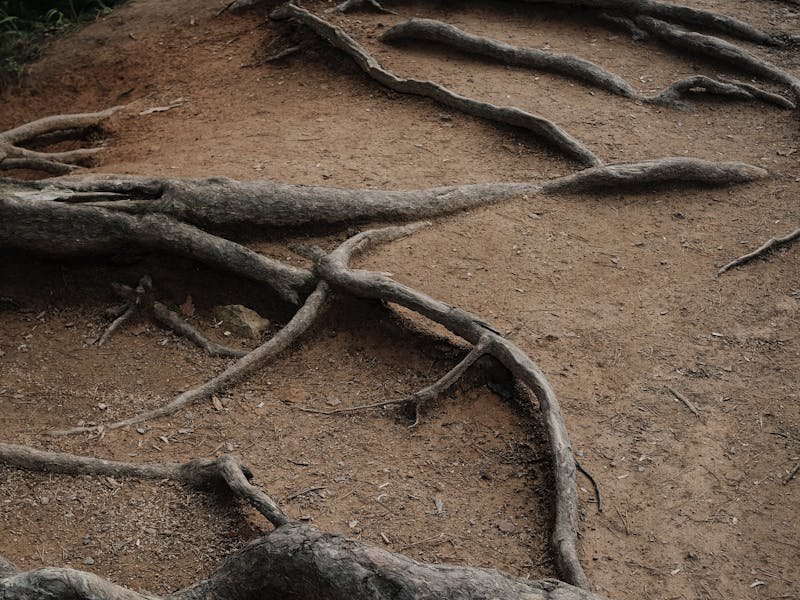
If you are planting new trees, or you are buying a house and trying to avoid future problems, there are some simple rules. Keep large shade trees at least 25 to 30 feet from any known sewer or water line. For the most aggressive species (silver maple, willow, poplar, sweetgum), push that to 40 feet or more.
Dogwoods, redbuds, Japanese maples, serviceberries, and crepe myrtles are examples of ornamental trees with less aggressive root systems. They can be planted much closer to lines without causing the same kinds of problems.
Root barriers are an option if you absolutely need a specific tree in a spot near a line. These are typically heavy plastic or fabric panels buried vertically in a trench between the tree and the utility. They redirect root growth downward. Installation runs 30 to 60 dollars per linear foot.
Alabama and Huntsville soil realities
The soil here matters more than most people realize. Much of Madison County sits on clay and limestone-based soils that drain slowly and hold moisture. Clay soil does not drain the way sandy soil does. Water sits around underground utilities longer, and roots have ample moisture to work with year-round. The same clay also shifts with seasonal wet-dry cycles, which stresses pipe joints and creates the tiny cracks that roots exploit.
Older Huntsville neighborhoods have a double challenge. Places like Twickenham, Blossomwood, and Five Points have gorgeous mature trees, but most of the homes were built on clay or cast iron sewer laterals somewhere between 1920 and 1960. Those pipes are now 65 to 100 years old. Every homeowner we talk to in those neighborhoods has either dealt with a sewer line problem already or is about to. If you are buying in one of those areas, get a camera inspection as part of your due diligence. Spending 300 dollars before closing can save you from a 12,000-dollar surprise six months after you move in.
Hampton Cove, Jones Valley, and the newer developments in Madison are generally in better shape because they were built with PVC. Problems there tend to come from extreme tree placement or unusually aggressive species rather than old pipe material.
If you think you have a root problem right now
Here is what I would do, in order. Get a sewer camera inspection so you know what you are dealing with. Figure out what trees are close to your sewer line and what species they are. Get a hydro-jet and a camera follow-up to assess the pipe condition after the roots are cleared. Then make a call about whether to repair, reline, replace, or remove the tree.
If the tree has to go, or if you just want to talk through whether it should, we are happy to come out and take a look. We know the older neighborhoods in Huntsville well, we know which species cause problems, and we can coordinate with your plumber to minimize disruption to your yard.
Tree roots in a sewer line are not the end of the world. They are a solvable problem, and there is a fix at every price point. The worst thing you can do is ignore the early signs, keep paying for emergency plumbing calls, and let a manageable situation turn into a structural one.