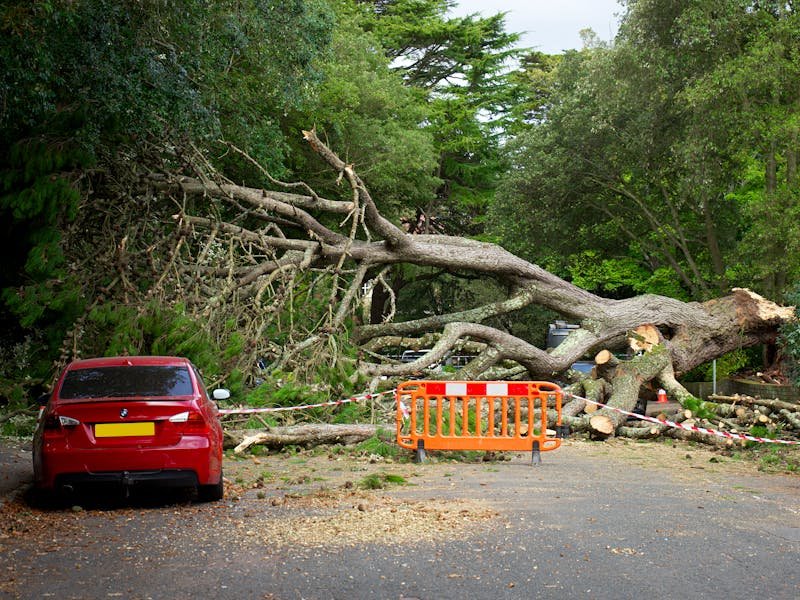
The tree is across the road. Cars cannot pass. Maybe the wind woke you up an hour ago, maybe you just rounded a corner and slammed the brakes. Either way, you are sitting there looking at fifty feet of pine or oak laying across both lanes, and you are wondering who is supposed to fix this.
I am going to walk you through it. We do this work in Huntsville and across Madison County all the time, and we get this call constantly during storm season. Two questions matter most right now: is anyone in danger, and whose road is this. Once you have the answers, the right phone call becomes obvious. If you are safe in your vehicle, pull over to the shoulder and turn on your hazards.
Step 1: call 911 if any of these are true
911 is for emergencies, not for routine road clearance. But the following situations are real emergencies and you need to dial right now.
The tree is on power lines or has lines tangled in it. Treat every downed line as live, even if you do not see sparks or hear humming. Energized lines can charge the ground, the tree, and any metal nearby. Stay back at least 35 feet. Call 911, then call Huntsville Utilities at (256) 535-4448 to report the line.
The tree hit a vehicle with people inside. If anyone is trapped, injured, or unable to get out safely, dial 911 immediately. Fire and EMS will bring the equipment needed to get people out. Do not pull on branches or try to lift sections of the tree to free someone, as you can make crush injuries worse.
The tree is blocking emergency access. If you are next to a hospital driveway, a fire station exit, or a road ambulances use to reach a critical area, call 911 and report it.
If none of those apply, you do not need 911. Skip to step 2.
Step 2: figure out whose road this is
This is the part that confuses people, and it is the single biggest reason calls get bounced from one agency to another. In and around Huntsville, six different jurisdictions might own the road you are standing on. Each one handles its own clearance and ignores everyone else's roads.
City of Huntsville street
If you are inside the Huntsville city limits and on a regular city street, this is Huntsville Public Works. Call 311 from any phone in the city, or dial (256) 427-5400 directly. Tell them you have a tree blocking the road, give them the cross streets, and let them know if there are any complications like power lines involved or if traffic is backing up.
City of Madison street
Madison is its own city with its own public works department, even though it sits next to Huntsville. If the tree is on a street inside Madison city limits, call Madison Public Works at (256) 772-5615. Same information: location, cross streets, hazards.
Madison County road (unincorporated)
A lot of the area around Huntsville is unincorporated Madison County. Places like parts of Meridianville, Harvest, New Market, Hazel Green, Toney, Gurley, and the rural roads outside the city limits fall under the Madison County Road Department. The number is (256) 532-3400. If you do not know if your road is city or county, look at where you pay your property tax bill or check the road sign style. County signs and city signs look different.
State highway (US 72, US 231, Memorial Parkway, etc.)
If the tree is on a state route, that is ALDOT, the Alabama Department of Transportation. ALDOT North Region can be reached at (256) 350-4290. State routes around here include US 72 (University Drive west of town and continuing through Madison and Athens), US 231 / 431 (Memorial Parkway), AL 53, and several others. If the road has a US or AL shield on the signs, it is a state route.
Interstate (I-565, I-65)
Interstates are also ALDOT, but the first call should be to the Alabama State Troopers because of how dangerous a blockage on an interstate is. Dial *HP (that is *47 on most cell phones) for the State Trooper highway hotline. They will get traffic stopped, set up the scene, and coordinate with ALDOT for the actual removal. You can also call 911 if it is a true emergency with vehicles involved.
Private road or HOA road
If the road is inside a gated community, a subdivision with private streets, or any kind of HOA-managed neighborhood, the city and county will not touch it. The HOA is responsible. Call your HOA management company or board. If there is no HOA and the road is just shared by neighbors, the property owners will need to handle it together by hiring a tree service. We get a lot of these calls in older developments and rural shared driveways around Huntsville and Madison.
Phone numbers to keep handy
Here is the short list. Save these in your phone if you live in the area. Storm season comes every spring and these numbers are the difference between a quick call and forty-five minutes of being transferred.
- Huntsville 311 / Public Works: (256) 427-5400
- Madison City Public Works: (256) 772-5615
- Madison County Road Department: (256) 532-3400
- ALDOT North Region: (256) 350-4290
- Huntsville Utilities (downed power lines): (256) 535-4448
- Alabama State Troopers: *HP (*47) from any cell phone
- Huntsville Police non-emergency: (256) 722-7100
Step 3: call the police non-emergency line if traffic is diverting
If cars are starting to drive around the tree on the shoulder, in the wrong lane, or through someone's yard, that is a traffic hazard even if the tree itself is not directly hurting anyone. Call the Huntsville Police non-emergency line at (256) 722-7100 and let them know. They can dispatch an officer to control traffic until public works arrives. This is especially important at night or on roads with high speed limits.
If you are in Madison or Madison County, the same logic applies. Madison Police non-emergency and the Madison County Sheriff both handle traffic control on calls like this.
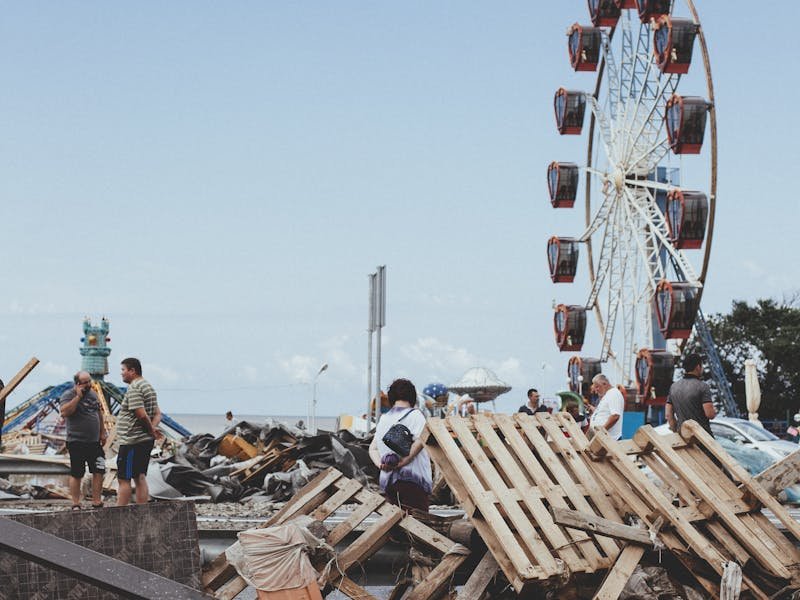
Who pays for the road removal?
This is the question I hear most often after the tree is already cleared and the dust has settled. Who is footing the bill?
For public roads, the agency that owns the road pays for the road clearance. The City of Huntsville pays to clear Huntsville streets. Madison County pays to clear county roads. ALDOT pays to clear state highways and interstates. They are using your tax dollars, of course, but the homeowner whose tree fell does not get a bill from the city for the chainsaw work and the dump truck.
That said, the agency only clears what is in the right of way. Trees that fell from private property and are partly on the road, partly on a yard, get cut at the road edge. The portion sitting on private property is the homeowner's problem to clean up.
For HOA-managed neighborhoods, the HOA pays for clearance and may then bill the property owner whose tree it was. Read your HOA covenants if you want to know exactly how that works in your subdivision. Some HOAs treat fallen trees as a community expense paid through dues, others assign costs directly to the lot owner.
What if the tree came from your property?
This is a separate concern. The road will get cleared either way. But if your tree fell on a public road and caused damage to a vehicle or injured someone, you may have liability exposure.
Alabama uses a negligence standard for these cases, the same as for trees that fall on a neighbor's property. The legal question is if you knew or should have known the tree was a hazard. A healthy tree taken down by a tornado or a microburst is generally treated as an act of nature, and you are not on the hook for damages. A dead tree that had been visibly rotting for two years and that you ignored is a different conversation.
If your tree did fall on a road, take photos of the root ball or the break point before any cleanup happens. The root ball tells you whether the tree was uprooted in healthy soil or whether it had been compromised by rot. The break point tells you whether the wood was sound or hollow. This kind of evidence matters if anyone tries to claim negligence later.
Call your homeowners insurance. Liability coverage on a standard Alabama homeowners policy generally covers damage to other people or their property caused by your trees, subject to the same negligence standard. Notify the carrier promptly so they can investigate while the evidence is still on the ground. We have a related write-up on what happens when a neighbor's tree falls on your property in Alabama that walks through the negligence framework in more detail.
Did your car get hit by a tree on the road?
Different scenario. You were driving, a tree came down across the road or onto your vehicle, and now you have a damaged car.
Your auto insurance handles this through your comprehensive coverage. Comprehensive (sometimes called "other than collision") covers damage from falling objects, including trees. If you carry comprehensive on your policy, file a claim with your auto carrier. If you carry only liability, you do not have coverage for tree damage to your own vehicle.
The city, county, or state does not pay for damage to your car when a tree falls on a public road. Even if the road agency was somehow at fault for not removing a hazardous tree on its right of way, sovereign immunity protections in Alabama make those claims very difficult. Most attorneys will tell you to file with your own auto carrier and move on. If your tree came from a private yard and the owner was negligent, your auto carrier may pursue subrogation against the owner's homeowners liability policy. That is your insurer's problem to chase, not yours.
For more detail on the auto side, our guide on what to do when a tree falls on your car in Huntsville covers the claims process and the steps that matter most.
Act of nature versus negligence
You will hear the phrase "act of God" thrown around in conversations about fallen trees. Lawyers and insurance adjusters use the phrase "act of nature" or "force majeure" to describe the same idea. The general principle is that nobody is liable for damage caused by extreme weather events that no reasonable person could have prevented.
Tornadoes, derechos, severe straight-line wind events, ice storms that snap healthy hardwoods, all of these tend to fall under the act-of-nature category. If a healthy tree comes down in a documented storm, the tree owner is not generally liable for the damage that tree caused. Insurance treats it as a covered peril and the policyholder's own coverage handles the loss.
Negligence is the opposite end of the spectrum. If the tree was already dying, leaning hard toward the road, hollow at the base, or had dropped large limbs in previous storms, and the owner was on notice and did nothing, that is a different story. A plaintiff's attorney can argue the owner had a duty to maintain the tree, breached that duty, and caused foreseeable harm.
Most cases sit somewhere in the middle, and that is where written documentation, photos, and arborist reports start to matter. If you live near a road and have any tree on your property that worries you, get it evaluated by a licensed tree removal company.
What not to do
I want to be direct here because we have seen all of these mistakes go wrong.
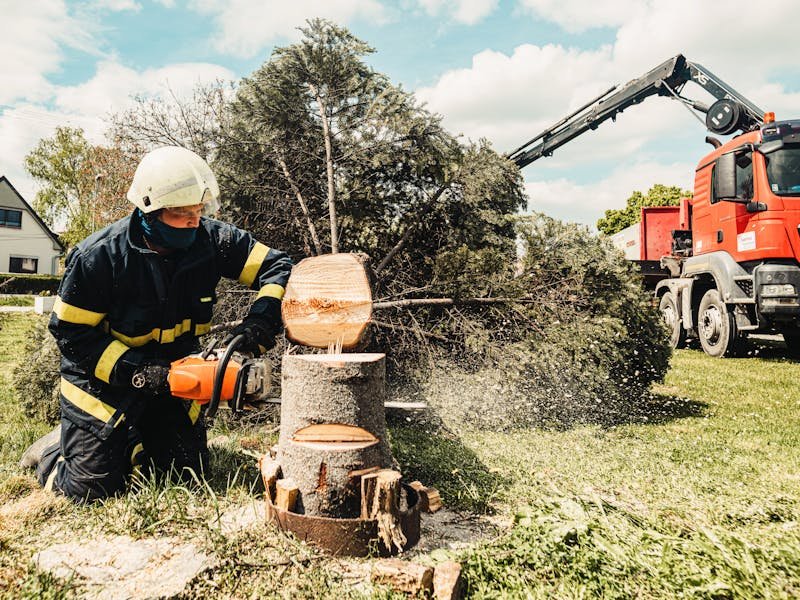
Do not try to move the tree yourself. Roadside chainsaw work is one of the most dangerous things an untrained person can do. The tree is under tension, limbs are loaded in ways you cannot see, traffic is moving past, and a kickback or snapped limb can put you in the hospital. Wait for public works or call a professional.
Do not cut on a tree that is tangled in power lines. Period. Even if the lines look dead, even if the power is out in the neighborhood, even if a neighbor said the line is just cable. Tree work near energized lines requires line-clearance qualified arborists with the right protective equipment, and even then, the utility usually has to de-energize the circuit first. Call Huntsville Utilities and wait.
Do not drive around the tree on the shoulder unless you have a clear, safe path and no oncoming traffic. People drive into ditches, hit downed wires, run over hidden debris, and cause secondary accidents this way. If the road is genuinely impassable, turn around and find another route.
Do not assume someone else has already called it in. The road crew dispatcher would rather get five reports of the same tree than zero. Make the call.
Storm response timing in Huntsville
After an isolated incident, like a single tree down on a quiet street, public works can usually be on scene within an hour or two during business hours. After a major storm, that timeline goes out the window.
When a real weather event hits the Tennessee Valley, the city, the county, and ALDOT all activate storm response protocols. There may be hundreds of trees down across the metro area at the same time. Crews work in teams, get assigned routes, and move through them on a priority basis. A single tree on a residential street might sit for 24, 48, or even 72 hours before a city truck reaches it.
This is not the agency being lazy. It is triage. There are only so many crews and so many chainsaws, and life-safety calls have to go first. Once those are handled, major arterials open up, then secondary routes, then neighborhood streets. If your road is the last on the list, you are going to be waiting.
If the wait is unacceptable, for example you cannot get out of your driveway and have a medical appointment, you can hire a private tree service. The catch is the agency will not reimburse you. You are paying for work that the public would have eventually done for free.
The post-storm priority system
Here is the order most agencies in our area follow after a serious storm. It helps to know this so you can set realistic expectations when you call.
First priority is life safety. Trees on occupied vehicles, trees on occupied homes, trees on power lines, trees blocking access to hospitals or fire stations, and any situation where someone is trapped or in immediate danger. These get crews dispatched first regardless of where the tree fell.
Second priority is major routes. Memorial Parkway, University Drive, Governors Drive, the interstates, and the main arterials that carry the bulk of traffic and emergency response. These need to stay open so ambulances, fire trucks, and utility crews can reach the rest of the city.
Third priority is residential streets and rural county roads. These are most of the calls and most of the trees, but they take the longest to reach. If you are on a quiet road in Huntsville or out in unincorporated Madison County, this is where you sit on the list.
If you need the tree cleared faster than the public crew can get there, that is when private emergency tree service comes in. We run 24-hour crews after major storms specifically because the public agencies cannot keep up with the volume. Our guide on 24-hour emergency tree service in Huntsville covers what to expect when you call us at 2 AM, and our overview of what happens during emergency tree removal walks through the on-scene process.
Bottom line: who do you call?
If anyone is hurt, if there are power lines involved, or if a vehicle is hit with people in it, call 911 first. After that, the agency you call depends on the road. City streets in Huntsville go to 311 or (256) 427-5400. City streets in Madison go to (256) 772-5615. Unincorporated county roads go to (256) 532-3400. State highways go to ALDOT at (256) 350-4290. Interstates go to Alabama State Troopers at *HP. HOA and private roads are on you and your neighbors.
Stay back. Do not cut on the tree yourself. Get photos if it came from your property. Call your auto insurance if your car was hit. And if the public crew is hours or days out and you cannot wait, call us at Huntsville Tree Pros. We work after-hours, we work in the rain, and we have cleared more storm-damaged trees off Madison County roads than I can count.