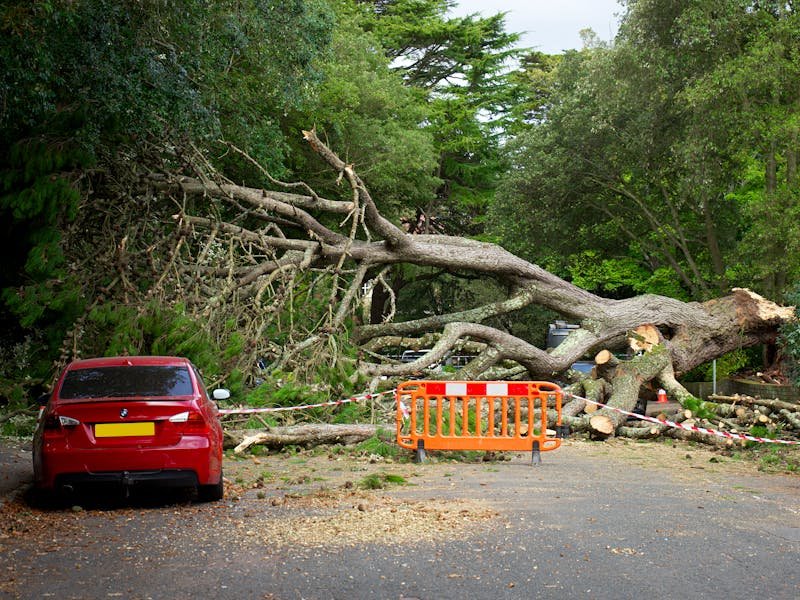
You open the front door after a bad night of thunderstorms, expecting to check a few branches in the yard, and instead you see your car sitting under what used to be a tree. Maybe the windshield is gone. Maybe the roof is caved in. Maybe the whole vehicle is buried in leaves and limbs and you cannot even tell yet how bad it is. Your stomach drops. You think about your commute in three hours, your deductible, whether this is going to ruin the next two months of your life.
I have stood in driveways with a lot of homeowners having exactly that moment. Take a breath. The damage is done, the car is not going anywhere, and what matters now is that you do the next few steps correctly. We run into this situation constantly at Huntsville Tree Pros, especially from March through June when the Tennessee Valley storms really get going. Here is what I would tell a friend if they called me from their driveway right now.
First: safety before anything else
I know you want to grab your phone and start taking photos. Do not do that yet. Before anything, look up and look around.
Is there a power line down in the yard? Power lines are the number one way this situation turns from expensive to catastrophic. A line that looks dead can energize the ground, the metal fence, the puddle you are standing in, and the car itself. If any line is down, or if the tree is tangled in utility wires above, stay back. Call Huntsville Utilities at 256-535-4448 and wait. Do not touch the car.
Do not start the engine. Starting it while a tree is pressing on the hood or roof can push debris into moving parts, short out compromised electronics, and in rare cases ignite a fluid leak. The car is not going anywhere safely on its own. It is going to come out on a tow truck.
And do not try to push, pull, or drag the car yourself. I have watched homeowners try to rock their car out from under a limb to avoid a tow fee. It is not worth it. You can tear body panels, damage the drivetrain, and turn a recoverable vehicle into scrap.
Second: document everything before anything gets moved
This is the step that separates a smooth insurance claim from a drawn-out fight with an adjuster. Before the tow truck arrives, before anyone touches the tree, get your phone out.
Take photos from every angle. Wide shots showing the whole scene with the house, the tree, and the car in the frame. Close-ups of the point where the tree contacts the vehicle. Photos of the roof, the hood, the windshield, the doors, and the trunk lid. Interior photos if you can get a door open safely, because water intrusion from a cracked windshield is damage too.
Photograph the tree itself. Get the root ball if it uprooted. Get the break point on the trunk if it snapped. A pine snapping in a storm tells a different story than a hollowed-out oak that should have been removed years ago, and that distinction matters if there is a liability question.
Video is even better than photos. Walk around the scene narrating what you see. Adjusters love video because it is harder to dispute than a still image. Do not move anything. Do not sweep up glass. The scene as it exists right now is evidence, and claims pay more when the evidence is preserved.
Does homeowners or auto insurance cover this?
This is the single most confusing part of the whole situation for most homeowners. So I am going to spell it out clearly.
Your car is a vehicle, not a structure. Homeowners insurance does not cover vehicle damage. Full stop. It does not matter that the tree was on your property. It does not matter that the tree hit your car in your driveway. Homeowners policies explicitly exclude motor vehicles.
The only insurance that pays to repair your car is your auto insurance policy, and specifically the comprehensive coverage portion of that policy.
Comprehensive auto coverage is the key
Comprehensive coverage handles damage to your vehicle from things that are not collisions. That includes falling trees, hail, fire, flood, vandalism, and hitting a deer. If you have comprehensive on your policy, a tree falling on your car is a covered event. You pay your comprehensive deductible (usually $250, $500, or $1,000), and insurance pays the rest up to the actual cash value of your vehicle.
This is true regardless of where the tree came from. Your own yard, your neighbor's yard, a city right of way, a parking lot at Bridge Street, it does not matter. Comprehensive covers tree damage to your car, period.
Liability-only means you are on your own
If you only carry liability auto insurance (the state minimum coverage that only pays for damage you cause to others), you are paying for this yourself. Liability does not cover damage to your own vehicle. A lot of folks with older cars drop comprehensive to save money, and most of the time that works out fine. Then one storm comes through, a tree comes down, and they are writing a check for $4,000 or scrapping the car.
If you are not sure what you have, pull up your policy or call your agent. Look for "comprehensive" or "other than collision" coverage. If it is there, you are covered.
Homeowners covers the tree, not the car
Your homeowners policy does not cover the car, but it may cover the tree removal from your property if the tree also hit a covered structure like your house, garage, or fence. If the tree hit only the car and nothing else, homeowners typically does not pay for the tree removal either. For more on how homeowners policies treat fallen trees, our guide to homeowners insurance and tree removal in Alabama covers the framework.
The good news is that comprehensive auto usually covers the cost of getting the tree off your vehicle as part of the claim, so you are not paying a separate crane bill out of pocket in most cases.
The deductible math
Before you file, run the numbers. Pull your policy and find your comprehensive deductible. Common amounts in Alabama are $250, $500, or $1,000.
Then think about likely repair cost. A windshield replacement alone runs $400 to $1,200. Roof dents typically run $1,500 to $4,000. A crushed roof that needs structural repair can run $6,000 to $15,000. Total repair costs for a tree-damaged car usually land between $3,000 and $10,000.
If the repair is $4,000 and your deductible is $500, you file. If your deductible is $1,000 and you are looking at a cracked windshield and a small roof dent that might total $1,400, get a repair estimate first, because filing for a $400 net payout can cause your premiums to tick up at renewal.
What if the tree came from someone else's yard?
Most people think they have a strong case to make the neighbor pay. Most of the time, that is not how it works.
In Alabama, a tree falling from one property onto another during a storm is generally treated as an act of nature. Your own comprehensive auto insurance is still the first call, even if the tree was rooted 40 feet away in your neighbor's yard. The neighbor is not automatically responsible just because the tree was theirs.
The exception is negligence. If the tree was visibly dead, dying, or dangerous, and you can prove your neighbor knew about it and did nothing, you may have a negligence claim. The key word is prove. Written documentation matters. A text or email saying "hey that dead pine on the property line looks ready to come down" is gold. Verbal conversations are your word against theirs.
Even in a strong negligence case, I tell homeowners to file the comprehensive claim first to get the car fixed, then pursue recovery of the deductible from the neighbor or the neighbor's liability insurance afterward. Waiting on a neighbor dispute to resolve can mean weeks or months without a vehicle.
What if the tree came from your own yard?
Still comprehensive auto insurance. Your coverage does not care whose tree it was. The car was damaged by a falling object, and that is what comprehensive covers. I have had customers who were genuinely worried that because the tree came from their own property they would be denied coverage. That is not how it works. Your insurer will process the claim the same way.
Getting the tree off the car safely
Do not try to cut the tree off the car yourself. I know a chainsaw is tempting. Please do not.
A tree resting on a car is under massive tension and compression in ways that are not obvious from the ground. Cutting the wrong limb can cause the trunk to snap down, roll sideways, or kick up. That is how you put a chainsaw through your thigh, or drop 400 pounds of oak through your rear window when you were trying to save it.
A professional emergency tree removal crew handles this differently. We use rigging lines to control which way the trunk moves as it is cut. We use cribbing to support load as we relieve pressure. For big trees we bring a crane and lift the tree straight off rather than cutting through it while it is still resting on the car. That controlled approach often means the difference between a repairable vehicle and a total loss. For more on what to expect, see our article on emergency tree removal.
The correct order of operations
Here is the sequence that works best: take all your photos and video. Call your auto insurance and file a comprehensive claim. They will assign a claim number and tell you to get the vehicle to a body shop for an estimate. Arrange professional tree removal so the tree comes off in a controlled way. The tow truck takes the car to a body shop. The shop writes an estimate. The adjuster either accepts or sends their own. Repairs get authorized, or the insurer issues a total loss payout.
Trying to do any of this out of order usually costs you money. Towing before the tree is safely off makes the tow dangerous. Getting the tree cut off before photos weakens your claim. Starting repairs before the adjuster has seen the damage gives the insurer a reason to deny portions of the claim.
What emergency tree removal costs in Huntsville
For a car-on-tree situation, emergency tree removal in Huntsville typically runs $400 to $1,500. The price depends on tree size, whether we can cut it off conventionally or need a crane, how difficult access is, and how quickly you need the work done. A mid-size tree we can section off by hand is on the lower end. A big oak that needs a crane runs higher. Tree work at 2 a.m. in the rain costs more than at 10 a.m. on a Tuesday.
If the tree is fully off the car and you need general tree removal and cleanup, rates come down. Your comprehensive auto insurance generally covers the tree removal cost as part of the vehicle claim. Keep the receipt and submit it to your adjuster.
Rental cars and getting around
If your policy includes rental reimbursement, your insurer will cover a rental car while yours is being repaired. Typical limits are $30 to $50 per day up to 30 days. Check your declarations page.
Without rental coverage, you are paying yourself, and in Huntsville that is usually $35 to $70 per day for a basic sedan. For a three-week repair that is a real bill. Borrowing a friend's second car, carpooling, or rideshare can save money. The Huntsville metro has decent Uber and Lyft coverage in core areas, but it thins out in Gurley, Toney, or New Market.
What if the car is totaled?
Sometimes the damage looks bad and the repair estimate confirms it. Insurance companies declare a vehicle a total loss when repair costs reach a certain percentage of the car's actual cash value. In Alabama, that threshold is typically 75 percent, though specific insurers use their own formulas.
If your 2012 Toyota Camry has an actual cash value of $8,000 and the tree caused $7,000 in damage, the insurer totals it. They write you a check for $8,000 minus your deductible, take the car, and you move on.
Total loss payouts are based on actual cash value, not what you owe on the car. If you are underwater on a car loan, the payout may not cover the loan balance, and you are on the hook for the difference. Gap insurance covers that shortfall. You can dispute a total loss valuation if you think the number is too low. Pull comparable listings from Huntsville dealerships and private sellers, adjust for mileage and condition, and send the data to your adjuster. I have seen homeowners recover an additional $800 to $2,500 this way.
Common mistakes I see homeowners make
Driving the car home before inspection. A cracked windshield can fail at 55 mph on I-565. A hit roof can have compromised roof rails. Get the car towed.
Skipping the photos. Adjusters pay what they can document. Two blurry photos and no video usually gets a smaller settlement than thorough documentation.
Calling homeowners insurance first. A lot of folks assume anything on their property is a homeowners claim. For vehicle damage, it almost never is. Call your auto insurer first.
Letting a friend cut the tree off with a chainsaw. They mean well, but they usually add damage to the car, and they have no workers compensation coverage if something goes wrong. Call a professional.
Accepting the first settlement offer. Adjusters start with the lowest reasonable number. If your body shop estimate is significantly higher, push back. Keep receipts for the tree removal, tow, and rental car. Many are reimbursable under the claim.
When the whole thing is just a bad day
Sometimes a tree falls on a car and nobody did anything wrong. No negligence, no preventable circumstance, just a storm that hit harder than the tree could handle. You pay your deductible, deal with a couple of weeks of inconvenience, and move on. Comprehensive coverage exists for exactly this.
If you are standing in your driveway right now looking at a car under a tree, I am sorry. It is a rough morning. But the damage is done, and what you do in the next few hours matters. Take the photos. Call your auto insurer. Call a tree service you trust.
If that last part is us, we answer the phone 24 hours a day. We have gotten trees off cars in Huntsville, Madison, Hampton Cove, Monte Sano, Jones Valley, and every neighborhood in between. We work with your insurance, document for the adjuster, and do it without adding damage to the vehicle.