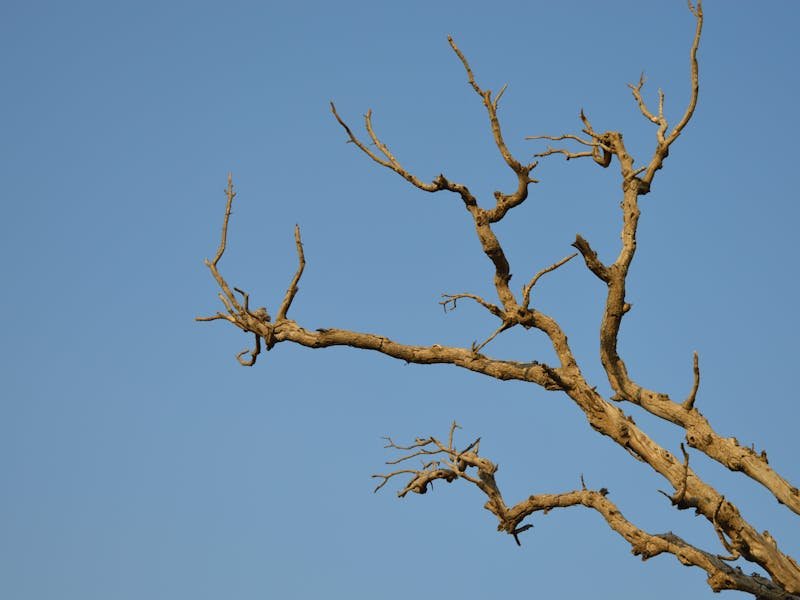
July rolls around in Huntsville, you walk out into your yard with a glass of sweet tea, and you notice your favorite shade tree is throwing yellow leaves all over the lawn. It is not fall. The tree is not supposed to be doing this. So is it dying? Should you panic?
Here is the short version: probably not. Most of the summer leaf drop I see across Madison County is a tree quietly trying to save itself. But the cause matters, and what you do in the next two weeks matters a lot.
The panicked phone call about summer leaf loss is one of the most common we get from June through September. So I want to walk through what is actually happening when a tree drops leaves, how to tell trouble from a normal stress response, and what I would do if it were my tree.
The 4 reasons trees lose leaves in summer
Before you do anything, you need to figure out which of these you are dealing with. The treatment is different for each one, and guessing wrong wastes time the tree does not have.
Drought stress (the most common one)
This is the number one cause of summer leaf drop in Huntsville, and it is not even close. When the soil dries out, the tree cannot pull enough water through its roots to keep every single leaf hydrated. So it triggers a survival mechanism. It drops some of its leaves on purpose to reduce the demand for water, the same way you would shed a heavy coat in the heat. Yellowing followed by browning at the leaf edges followed by leaf drop is the classic pattern.
Heat stress (it is not the same thing as drought)
People lump these together, but they are different. Heat stress happens when air and surface temperatures spike high enough that the tree cannot transpire fast enough to cool itself, even when the soil has plenty of moisture. You see scorched-looking leaves, often on the south or west side of the tree where the afternoon sun hits hardest. The tree might have wet roots and still be miserable.
Disease
Fungal and bacterial leaf diseases pick up in late summer when humidity stays high and rain finally returns. Anthracnose, leaf spot, and various wilts can all cause leaves to drop. The tell here is that you see actual lesions, spots, blotches, or strange patterns on the leaves before they fall. Not just generic browning. If you want a deeper look at what shows up around here, our guide on common tree diseases in north Alabama covers the main ones.
Insect damage
Bagworms, webworms, scale, and aphids can all defoliate a tree fast in summer. With insects you usually see chewed leaf edges, holes in the leaves, sticky residue (honeydew) coating the leaves and the ground underneath, or sometimes obvious webbing or bag-like structures hanging from branches. Insect-driven leaf drop tends to be patchy at first, then spreads.
How to tell drought stress from disease (or bugs)
Walk up to the tree. Pick up a few of the fallen leaves and look at them closely. Then look at the leaves still on the tree. The pattern usually tells you what is going on.
Drought stress: leaves turn yellow, then brown from the edges inward toward the center. They feel papery and dry. They drop fairly suddenly, often in a single hot week. The whole tree is affected somewhat evenly, though the highest branches and the most sun-exposed sides usually go first.
Disease: you see actual spots, lesions, blotchy patches, or weird discoloration in distinct shapes. Progression is gradual, often starting on lower or interior branches where airflow is poor. Leaves might curl, twist, or look distorted before they brown.
Insect damage: leaves have chewed edges, ragged holes, or skeletonized patterns where only the veins remain. You might see frass (insect droppings) on the leaves below, or sticky honeydew. The damage is often clustered on certain branches.
If your tree is dropping clean, dry, edge-browned leaves with no visible spots or chewing, you are almost certainly looking at drought stress. That is good news, because it is the easiest one to fix.
Huntsville's typical summer drought pattern
The Tennessee Valley follows a predictable rhythm. Spring is wet. Then somewhere around mid-June, the rain starts to back off. By the second week of July we are often in a real dry stretch, and August is the hottest, driest month on average. The first decent rain usually does not return until mid to late September.
So when you see leaves dropping in late July or early August, you are seeing the cumulative effect of six to eight weeks of inadequate rainfall combined with daily highs in the 90s and overnight lows that barely dip below 70. A green lawn does not mean a happy tree. The lawn has shallow roots and you have probably been watering it. The tree has roots that go several feet deep, and surface watering does not reach them.
Trees most likely to struggle in a Huntsville summer
Some trees just are not built for our climate, or they have characteristics that make them fragile when the rain stops. If you have any of these, watch them closely from July through September.
Dogwoods. Beautiful in spring, miserable in August. Their roots are shallow, they prefer dappled shade, and they cook in full sun. Dogwoods planted in open lawns are almost always the first trees to show drought stress in Madison County.
Newly planted trees, anything under 3 years old. The root system has not extended yet. Even native species are vulnerable until they have had a couple of full growing seasons to establish.
Birches, especially river birch and white birch. They love water and they let you know when they are not getting it. Birches drop leaves at the first sign of drought.
Sweetgums. They handle a lot but they are heavy water users. In a long drought they drop leaves and seed balls together.
Maples planted on lawns, particularly red maples and silver maples. Their roots compete with grass for the same shallow water, and they lose.
Trees that handle our summers like champions
On the other end of the spectrum, some trees barely notice when it does not rain for a month. If you are planting new trees and you want to skip the summer worry, lean toward these.
Native oaks. White oak, post oak, blackjack oak, and southern red oak all do well once established. Their root systems go deep, they tolerate our clay soils, and they have been surviving Alabama summers since long before any of us got here.
Eastern red cedar. Practically indestructible. Drought, heat, poor soil, none of it bothers a mature cedar.
Hackberry. Tough, fast-growing, drought-tolerant, and underrated. You see them all over Huntsville on roadsides and fence rows because they thrive without help.
Native pines. Loblolly and shortleaf pine handle our summers fine once their roots are down. They are the dominant timber species in north Alabama for a reason.
The "panic drop" and why it is actually a good sign
Sometimes a tree drops a noticeable percentage of its leaves in a short period during summer. It looks alarming. The yard is covered in yellow leaves overnight. The canopy looks thinner. Your first thought is that the tree is dying.
What is actually happening is the tree is doing exactly what it evolved to do. Faced with not enough water, it sheds leaves to reduce its water demand. Fewer leaves means less surface area transpiring water, which means the remaining roots can keep up. A tree that does this is a tree that knows how to take care of itself.
This kind of leaf drop is recoverable. Once you start deep watering, the tree stabilizes, and it usually flushes out a partial second leaf set if conditions improve. The key is recognizing the panic drop early and responding with water. A tree that gets help within a week or two almost always pulls through.
When leaf loss actually means the tree is dying
Now the harder conversation. Sometimes summer leaf drop is not a survival response. It is the final stage of a tree that is already past saving. Here is how to tell the difference.
Brown leaves that stay attached. A healthy stressed tree drops its damaged leaves to conserve energy. A dying tree cannot even manage that. If you see leaves that have turned crispy brown but are still hanging on the branches weeks later, that is a serious warning sign.
Bark cracking, splitting, or peeling away in sheets. Healthy bark stays put. Bark that is shedding off the trunk in chunks usually means the cambium underneath has died.
No bud formation for next year. Trees set their buds for the following spring during summer. By August you should be able to see small, firm buds at the leaf nodes and at branch tips. If a tree has dropped its leaves and there are no buds forming, that is bad.
Mushrooms or shelf fungus growing at the base or on the trunk. These usually mean root rot or internal decay is well advanced. The tree might still be standing for a while, but structurally it is going.
A simple field test: scratch a small section of bark on a young branch with your thumbnail. Green tissue underneath means the branch is alive. Brown, dry, brittle tissue means it is dead. Try this on several branches around the tree. If the whole crown is brown, the tree is in serious trouble. If you find mostly green with a few dead branches, you have a stressed tree that can probably be saved. Our guide on telling if a tree is dead or just dormant goes deeper into this test.
Deep watering, the right way
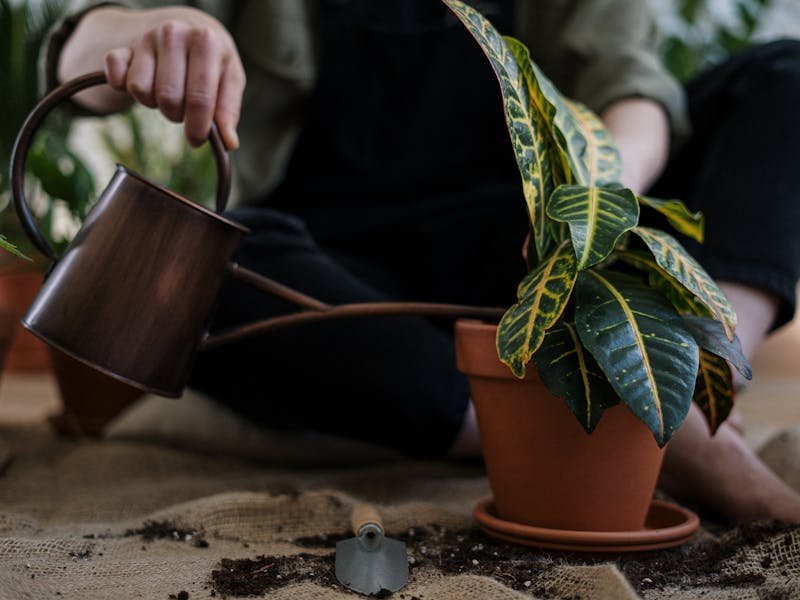
If your tree is showing drought stress, water is the answer. But how you water matters as much as how much you water. Most homeowners do this wrong.
The wrong way: a quick spray with the garden hose every day. This wets the top inch of soil and trains tree roots to stay shallow, which makes the tree even more vulnerable next year. It also evaporates almost immediately when the sun comes up.
The right way: deep, infrequent watering. Once or twice a week, you want to soak the soil to a depth of 8 to 12 inches. That means leaving water running slowly in one spot for a long time so it has a chance to soak down rather than running off across the surface.
The easiest tool is a soaker hose. Lay it in a circle at the drip line of the tree, which is the area on the ground directly under the outer edge of the canopy. That is where the feeder roots are. Watering at the trunk does almost no good because the roots that absorb water are out at the canopy edge, not next to the bark.
Run the soaker hose for 30 to 60 minutes on low pressure. For very large trees, move it around the drip line and do this in two or three sections. A rough rule is 10 gallons of water per inch of trunk diameter, twice a week during a real drought.
Do this in the early morning or evening so less of it evaporates. Skip the middle of the day. For a complete walk-through, our tree watering guide for Alabama summers has the full schedule.
Mulch like you mean it (but not too much)
Mulch is the cheapest, most effective drought protection you can give a tree. A 3-inch layer of wood chip mulch around the root zone holds moisture in the soil, keeps the soil temperature stable, and stops the lawn from sucking up water meant for the tree.
Spread it in a ring that extends out toward the drip line, the wider the better. Three inches deep is about right. Pull the mulch back from the trunk so it does not actually touch the bark. You want a doughnut, not a volcano.
The "mulch volcano" mistake, where homeowners pile mulch up against the trunk in a cone shape, is one of the most common things I see, and it is genuinely harmful. It traps moisture against the bark, invites fungal disease, and encourages roots to grow up into the mulch instead of down into the soil. Keep mulch a few inches away from the trunk. If you want the full breakdown, our mulching guide for Huntsville homeowners covers it.
The lawn versus tree water competition
Here is something a lot of homeowners do not realize. If your tree is growing in the middle of a lawn, your grass and your tree are fighting for the same water, and the grass is winning.
Turf grass has dense, shallow roots in the top 4 to 6 inches of soil. When you water the lawn with a sprinkler, the grass intercepts almost all of that moisture before it has any chance to soak down to the tree's deeper roots. The tree gets the leftovers, which during a drought is basically nothing.
This is why a tree on a lawn often shows drought stress even when the lawn looks fine. The grass is hogging the water. Mulching out the lawn from around the tree (creating a mulch ring at least out to the drip line) eliminates that competition and is one of the single best things you can do for tree health in summer.
Heat stress when watering is not enough
Sometimes you do everything right with the water and the tree still looks rough. The soil is moist, you are deep watering twice a week, the mulch is in place, and the leaves are still scorching. That is heat stress.
When daytime temperatures sit in the upper 90s for days at a time and overnight lows stay above 75, even a well-watered tree struggles. The transpiration rate cannot keep up with the heat load. You will see scorched edges and tip burn on leaves, often concentrated on the hottest sides of the tree.
There is not much you can do for heat stress in the moment besides keep the soil moist and wait for the temperatures to break. Trees handle a few weeks of brutal heat fine as long as they have water. The damaged leaves might drop, but the tree itself is not dying. Healthy soil moisture, mulch, and patience are the answer.
Long term, a tree that struggles year after year with heat stress might benefit from a deep fertilization in early spring to strengthen the root system before summer hits. Our tree fertilization service handles this with a deep root feeding that supports vigor through the dry season.
When it is time to call somebody
Most summer leaf drop you can handle yourself with a soaker hose and a bag of mulch. But there are situations where it makes sense to bring in a certified arborist for a real assessment.
If multiple trees on your property are dropping leaves at once, especially if they are different species, something bigger is going on. Could be soil contamination, root damage from construction, an irrigation problem, or a disease moving through the area.
If a large mature tree (anything over 40 feet) is showing serious decline, the stakes are too high to guess. Big trees fall on big things, and a hazardous tree near your house is not something to wait on.
If you suspect disease and you see actual leaf spots, lesions, or strange growths, get an arborist to diagnose it before it spreads to other trees. Some of the fungal diseases that show up in Huntsville can take down a whole row of trees if untreated.
And if you have done everything right, watered deeply for two or three weeks, and the tree is still going downhill, get a professional opinion. An arborist consultation can identify root issues, internal decay, or pest problems that are not visible from the ground.
The reality of summer in north Alabama
Trees in Huntsville live through tough summers. Hot days, dry stretches, heavy clay soil, and brutal afternoon sun are part of the climate. Most healthy trees handle it fine. The ones that struggle were usually planted in the wrong spot or are not native species suited to our conditions.
If your tree is dropping leaves in July, do not panic. Walk out, look at the leaves, scratch a branch. Nine times out of ten you are looking at a tree that needs water and would do just fine with a soaker hose, a ring of mulch, and a little patience. If something feels worse than that, give us a call.