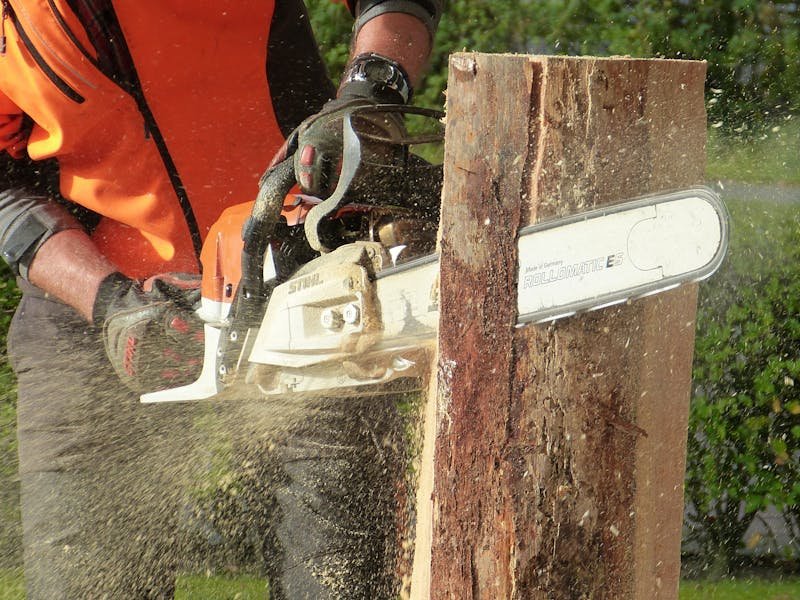
People call us asking for tree removal when what they actually want is tree cutting. It happens almost every day. Someone calls because a few limbs are scraping their roof, or the canopy is blocking their view of Monte Sano, or one big branch came down in a storm. They use the words "tree removal" because that is the phrase that comes to mind, but the work they need is something different. They want the tree to stay. They just want part of it gone.
I want to walk through what tree cutting actually means, how it differs from removal, what it costs in Huntsville, and when each one is the right call. Most of what I am about to share comes from the calls I take and the jobs we run in north Alabama, not from a textbook. The pricing is real 2026 Huntsville pricing.
What "tree cutting" actually means
Tree cutting is selective work. The tree stays standing. We are removing specific parts of it for a specific reason.
That can mean cutting a single large limb that is hanging over your roof. It can mean removing a section of the canopy that is blocking your view. It can mean clearing branches away from a power line, or cutting back the side of a tree that is touching your house. It can mean reducing the height of a few branches so a solar panel array gets more sun. It can mean cleaning up storm damage by removing the broken sections and leaving the rest of the tree to recover.
What it is not is full removal. We are not taking the trunk down. We are not grinding the stump. The tree continues to live and grow after we leave. That is the whole point. Cutting requires understanding where to make a cut so the tree heals properly. Cut in the wrong place and you create a wound that rots. Cut too much and you stress the tree into decline. The skill set overlaps with removal but it is not the same skill set.
The reasons people actually need tree cutting
When I look back at the cutting jobs we ran last year, the reasons cluster into a few clear categories.
View clearing
This is huge in Huntsville. We have real terrain here. Monte Sano sits 1,600 feet above the city. Big Cove and Hampton Cove sit in valleys with mountain views on both sides. The Tennessee River cuts through the south end of town. People pay a premium for homes with views, and over the years the trees grow up and the view goes away.
Cutting for view clearing is delicate work. We are trying to open specific sight lines from specific windows or specific spots in the yard. That usually means selectively reducing the upper canopy of trees on the downhill side of the property, removing some lower limbs, and sometimes taking out individual smaller trees that are growing into the view corridor. Done right, the trees still look natural and stay healthy.
Solar panel access
Solar has gotten more popular here over the last few years. A lot of older Huntsville lots have mature canopy on the south and southwest sides of the house, which is exactly where the panels need clear sun. Most homeowners do not want to cut down their oaks. They just want enough canopy reduction to make the panels work. We take some height off, thin the upper crown so light gets through, and sometimes remove a few specific branches that throw shade on the array during peak hours. The tree keeps most of its mass and most of its appearance.
Storm damage cleanup that does not need full removal
Spring and summer storms in the Tennessee Valley take limbs off trees constantly. A lot of the time, the rest of the tree is fine. The cutting work is just removing the broken sections, making clean cuts where the breaks happened, and getting the tree back to a stable shape. When a customer calls after a storm, the first question I ask is whether the trunk is intact and whether the root system looks undisturbed. If both answers are yes, we are usually looking at a cutting job, not a removal.
Power line clearance
Branches growing into power lines are dangerous and usually a code issue. Huntsville Utilities handles their main service lines, but the drop from the pole to your house, the line that comes down to your meter, is your responsibility once it crosses onto your property. We take out the specific branches in the line corridor, leaving the rest of the tree alone, and create enough clearance that future growth does not become a problem for two or three years.
Roof and structure clearance
Branches scraping a roof shorten the life of shingles. Branches over a roof drop debris in gutters and create leak points. Branches touching siding wear paint off and create a moisture problem. We pull the canopy back from the structure by 6 to 10 feet, leaving the tree intact and giving the roof room to shed water. This is one of the most common cutting calls we get.
Crown thinning for storm preparation
A dense canopy catches more wind than a thinned one. For mature trees that sit close to a house in storm-prone areas like Hampton Cove or Owens Cross Roads, selective thinning of the upper canopy reduces the wind load and makes the tree less likely to come down or lose major limbs in a thunderstorm. It is removing a small percentage of interior branches and small upper limbs to let wind pass through the canopy more easily. Done properly, the tree looks essentially the same to a casual observer but handles 60 mph gusts much better.
Cutting versus full removal: how to know which one you need
Here is the decision tree I walk customers through on the phone.
Is the tree dead? If yes, you need tree removal, not cutting. Cutting limbs off a dead tree does not save it because there is nothing to save. Is the trunk damaged or hollow? If yes, removal. A compromised trunk is a structural problem you cannot fix with cutting. Is the tree leaning toward a structure? Probably removal. Cutting branches off a leaning tree does not address the lean. Are the roots damaged or exposed? Removal is usually the safer call.
Is the problem just a few limbs, a portion of the canopy, or a specific clearance issue? Cutting. The tree is fundamentally healthy and you are doing targeted work. Is the tree in the wrong place but otherwise healthy? Gray area. If a tree is going to keep growing into a structure, cutting it back every two years gets expensive over time, and removal eventually wins on cost.
The Huntsville view-clearing market
The premium home market in Monte Sano, Hampton Cove, McMullen Cove, Big Cove, and parts of south Huntsville is built on views. The value of these homes goes up when the view is clear and goes down when the canopy fills in. Homeowners in these neighborhoods understand this and they budget for view maintenance the same way they budget for landscaping.
Monte Sano is the most demanding work. The terrain is steep, the lots are wooded, and the views down to the city are what people pay for. Cutting up there usually involves rope work, careful selection of which trees to thin, and attention to the natural look of the cut. Nobody wants the cleared view to look obviously cut.
Hampton Cove is flatter and the views are usually toward the mountains. Cutting tends to focus on lower canopy and selective removal of smaller trees that grow into the sight lines from the back of the property. McMullen Cove has the strictest HOA rules of the three. Almost any significant cutting requires approval from the architectural committee. Working there means doing the paperwork before the chainsaw work.
What tree cutting service costs in Huntsville
Cutting costs less than removal. The trunk stays in place, there is no stump, the cleanup is smaller, and the equipment requirements are usually lower. Here are the ranges I quote in 2026 for typical Huntsville work.
Basic limb cutting on an accessible tree, where we are taking off a few specific branches, usually runs $150 to $500. The variables are how big the limbs are, how high in the tree they sit, and the access for equipment. A single oversized limb that requires rope work or a bucket truck pushes higher. A handful of medium branches on a 30-foot tree in an open yard sits at the lower end.
View clearing usually runs $400 to $1,500 for a typical residential job. This range covers selective canopy reduction across multiple trees, opening up sight lines, and debris cleanup. Larger lots with extensive canopy work or steep terrain push higher.
Partial canopy reduction on a single mature tree, the kind of job we run for solar access or storm preparation, generally lands between $300 and $1,200. The driver is tree size and how much canopy is being touched. Crane-assisted work, which we sometimes need on tight residential lots in central Huntsville or hillside homes, adds $500 to $1,500 in equipment cost. For a comparison point, our breakdown of tree removal cost in Huntsville covers what full removals run.
The risks of bad tree cutting
Cutting done badly can be worse than no cutting at all. The biggest risk is overcutting. If we take more than 25 percent of the live canopy off a healthy mature tree in a single visit, we push it into stress. The tree responds by sending up a flush of weak suckers, called water sprouts, that grow fast and structurally poor. Those sprouts are exactly the kind of growth that breaks off in storms three years later. Meanwhile the tree is fighting to recover the photosynthesis capacity it lost, which makes it more vulnerable to disease and insect attack.
The next biggest risk is topping. Topping is when someone cuts the main vertical leader of a tree and reduces the height by chopping back major branches to stubs. It is the worst thing you can do to a tree, and it is unfortunately common when homeowners hire the cheapest available crew. A topped tree almost always dies within five years.
If a quote you receive talks about "topping" the tree, "rounding it over," or "taking it down by half," walk away. That is not professional cutting work. Cuts made in the wrong spot, or cuts that leave stubs, do not heal properly either. The tree cannot seal the wound, water gets in, and rot travels down from the cut over the next few years. For more on what proper pruning looks like, our piece on tree pruning, when, why, and how gets into the technical side.
Permits and HOA rules for tree cutting in Huntsville
For most private residential cutting work in Huntsville, you do not need a city permit. Trees on your property are your property, and you can have them cut without involving the city. The exceptions matter.
Trees in the public right-of-way along the street are city-managed in Huntsville. The right-of-way usually extends 10 to 15 feet back from the curb, depending on the street. If a tree is in that zone, it is technically the city's tree, and cutting it without authorization can get you a citation. The Huntsville Public Works department handles right-of-way trees and generally responds to homeowner requests if the tree is causing a real problem.
HOA-controlled neighborhoods are where most of the cutting drama happens. McMullen Cove, The Ledges, parts of Hampton Cove, parts of Jones Valley, and several newer developments have written rules requiring HOA approval before any tree work over a certain scope. The rules vary. Some require approval for any tree over a certain diameter. Some require approval only for full removal. Some require approval for any cutting visible from the street. Read your covenants before you schedule the job, not after.
If you live in a deed-restricted neighborhood, the HOA rules are usually the binding constraint. We have had to walk away from cutting jobs at the last minute because the homeowner did not check the HOA rules and the architectural committee said no. I now ask the question on the first phone call.
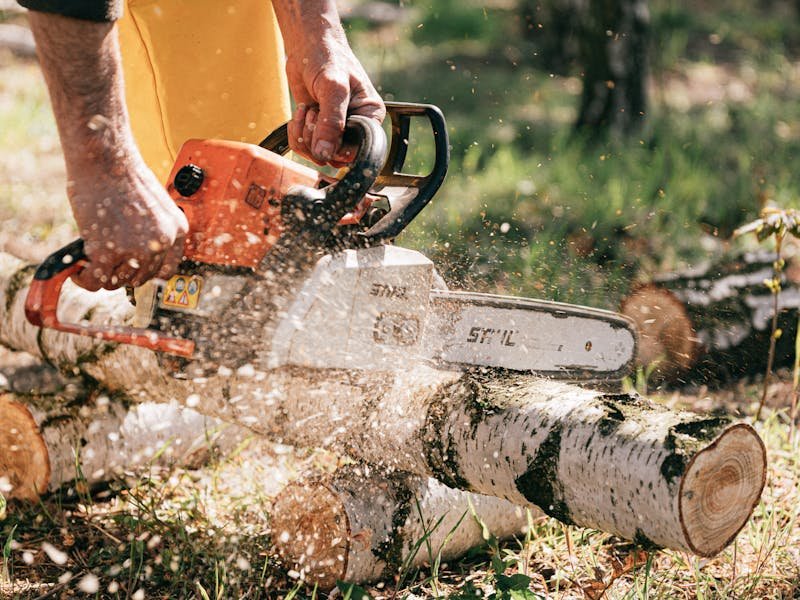
DIY chainsaw work and why I keep telling people not to do it
Chainsaw injuries are one of the leading causes of home-related emergency room visits in Alabama. The Consumer Product Safety Commission tracks tens of thousands of chainsaw ER visits every year nationally, and Alabama's per-capita rate is higher than the national average. Tree-related injuries account for a meaningful share of those visits in our state.
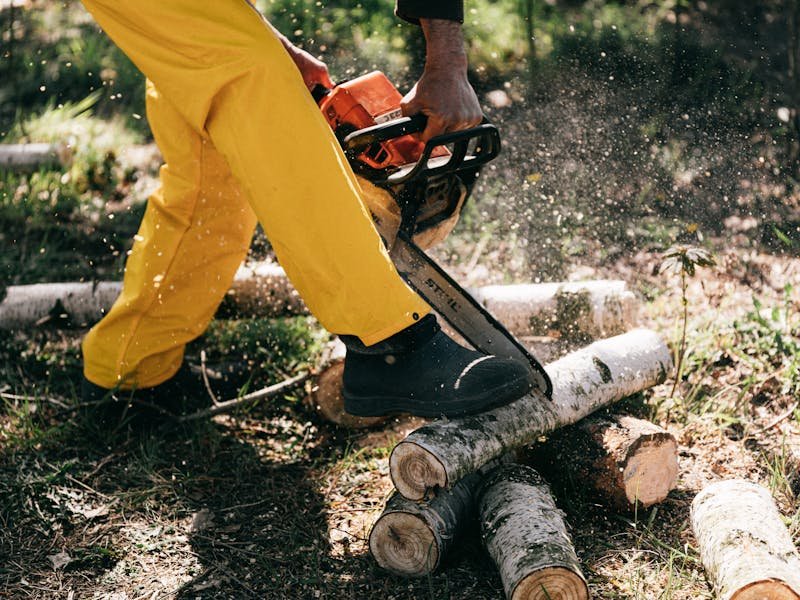
The mechanics of how people get hurt are predictable. Kickback from the chainsaw is the most common cause. The bar of the saw catches at the tip and the saw whips back toward the operator's face or upper body. The cutter standing under the limb they are cutting and getting hit when the limb falls in an unexpected direction is also common. So is ladder failure, where the cutter is up on a ladder leaning into the tree and the ladder kicks out as they put weight on the saw.
If you are going to cut your own limbs, limit it to small branches you can reach from the ground. Anything above shoulder height on a ladder is high-risk. Anything thicker than your wrist takes more skill to drop safely than people realize. Anything near a power line should be a hard no. Your homeowners insurance does not cover injuries from your own chainsaw, and the savings on a $300 cutting job evaporate the moment you are in the ER getting stitched up.
How to find a legitimate tree cutting service
The cutting industry has a wide quality range. There are real professionals doing careful work, and there are guys with a chainsaw and a pickup truck who picked up a few jobs through a Facebook group last weekend. Both will quote you. Telling them apart matters.
Insurance is the first filter. Ask for proof of general liability insurance and workers compensation. Get the certificate sent to you directly from the insurance carrier, not a photo of a piece of paper. If a cutting crew gets hurt on your property and they do not have workers comp, your homeowners insurance can be on the hook for the medical bills. This is the single most common reason homeowners get burned by cheap cutting jobs.
References from local jobs are the second filter. A legitimate Huntsville cutting service can give you addresses of recent cutting work, ideally in your neighborhood. Drive by and look at the trees. Cuts done six months ago should look clean, with proper collar cuts and no stubs.
A written scope of work is the third filter. The quote should describe what is being cut, what is being left, where the debris goes, and what the price covers. Vague quotes like "trim the trees, $1,200" leave you with no recourse if the work does not match what you were expecting. A good cutting service will also look at your trees, ask questions about what you are trying to achieve, and tell you whether cutting is even the right answer. If the only answer they give you is "yes, we can cut that," without asking what you are trying to accomplish, they are selling rather than diagnosing. Walk away.
For the relationship between cutting and the broader category of tree pruning, our tree trimming page gets into how we approach this work day to day.
When you are ready to talk through your project
If you have a tree problem and you are not sure whether you need cutting or removal, that conversation usually takes me about ten minutes. I look at the tree, I ask what you are trying to accomplish, and I walk you through the options with real prices.
Sometimes the answer is full tree removal. Sometimes the answer is selective cutting that solves the problem for a fraction of the cost. Sometimes the answer is "leave it alone, the tree is fine, your neighbor is wrong about it." All three of those are honest answers, and you should expect that mix from any cutting service that knows what it is doing.
We work across Huntsville, Madison, Decatur, Athens, Hampton Cove, Monte Sano, and the rest of Madison County. If you want a free assessment of what your tree actually needs, give us a call or send a request through the form. We will tell you what we see.