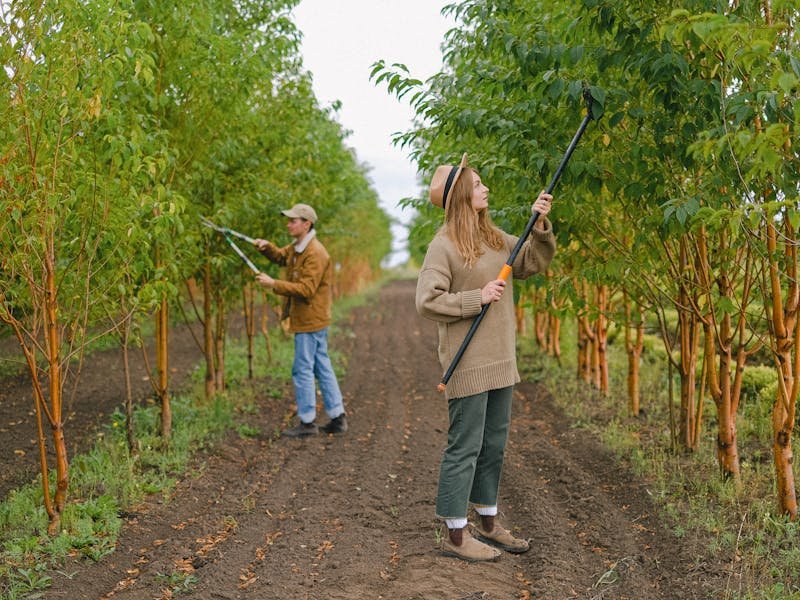
Pruning sounds simple until you actually try to do it well. People use pruning, trimming, and cutting almost interchangeably, but they mean different things, and confusing them is how perfectly good trees end up ruined.
Pruning is the deliberate, selective removal of specific branches for a reason: health, structure, safety, or appearance. Trimming is the lighter, more cosmetic version, often done on shrubs or smaller branches. Cutting, the way most homeowners use the word, usually means whacking off whatever is in the way without much thought. The first one helps a tree. The third one usually hurts it.
I have pruned trees in the Tennessee Valley for years. Below is the basics the way I would explain them to a neighbor over the fence: what each type of pruning does, when to prune the trees you most likely have in your yard here in Huntsville, and the mistakes I see in residential yards almost every week.
Why pruning matters
Pruning serves four purposes, in this order of importance: health, structure, safety, appearance.
Health comes first because a tree with dead, diseased, or rubbing branches is fighting itself. Removing dead wood stops decay from spreading into healthy tissue. Thinning a dense canopy lets air and light through, which reduces fungal pressure in our humid Alabama summers.
Structure is next. The shape a tree develops in its first 10 to 15 years determines whether it grows into a strong specimen or a problem tree with co-dominant trunks and weak branch unions that will break in the next ice storm. Structural pruning while a tree is young is the highest return on investment you can make for its long-term health.
Safety covers the obvious: branches over the roof, dead wood that could fall on someone, branches growing into power lines. Most safety pruning should be preventive, not reactive.
Appearance is last because it should be. A well-pruned tree looks good as a side effect of being healthy. When people prune purely for looks, that is when bad things happen, like topping and lion-tailing.
The 5 types of pruning, explained
Most pruning falls into one of five categories. A good arborist will tell you which type they are doing and why before they start cutting.
Crown cleaning
Crown cleaning is the removal of dead, dying, diseased, broken, and crossing branches from the canopy. This is the most basic and most common type of pruning, and what most mature trees need. Nothing aggressive, no shape changes, just taking out wood that should not be there. It carries very little risk because you are only removing material the tree was already going to shed.
Crown thinning
Crown thinning is selective removal of live branches throughout the canopy to improve light penetration and air movement. Useful for trees with very dense canopies, especially in mature Huntsville oaks where the inner canopy can get so packed that no light reaches the lawn underneath.
Done right, thinning makes the tree look more open while reducing wind resistance and storm damage risk. Done wrong, it turns into lion-tailing. Thinning should be done evenly throughout the canopy, not just at the tips.
Crown raising
Crown raising is removing the lowest branches to provide clearance underneath. This is the pruning you do so people can walk under the tree, cars can use the driveway, or lower branches stop scraping the roof.
You are removing structural support, though. Lower branches anchor the tree, and removing too many at once can make a tree top-heavy. As a general rule, the live crown should make up at least two-thirds of the tree's total height after raising.
Crown reduction
Crown reduction is shortening the overall height or spread of a tree. Sometimes necessary for trees encroaching on power lines or too tall for the structures around them. Done correctly, it involves cutting back to lateral branches that are at least one-third the diameter of the limb being removed, so the lateral takes over as the new leader.
Crown reduction is not topping. Topping is just chopping the top off at a uniform height. Reduction follows the natural form of the tree. Most homeowners cannot tell the two apart from the ground until six months later when the tree starts to react.
Structural pruning
Structural pruning is what you do to young trees to set them up for a long, healthy life. The goal is to develop a strong central leader, eliminate competing co-dominant stems, and establish well-spaced scaffold branches.
Most homeowners skip this entirely. They plant a tree, water it for a year, then let it grow however it wants for 20 years. Then they call us when a major branch fails or two competing trunks split apart in a storm. A young tree pruned correctly two or three times in its first decade is dramatically less likely to develop those problems.
When to prune the trees you actually have in Huntsville
Timing matters a lot, and it is species-specific. Here is what I tell people about the most common trees we see in Madison County yards.
Oaks: winter only
Oaks are where timing is most critical. Prune oaks only during the dormant season, roughly November through February in Huntsville. Do not prune oaks from April through July under any circumstances.
The reason is oak wilt, a fatal fungal disease spread by sap-feeding beetles active in spring and early summer. A fresh pruning cut on an oak during that window is essentially an open invitation for those beetles, and oak wilt can kill a mature tree in a single growing season. The disease is moving south, and the risk is real. Just wait for winter.
Maples: late summer or fall
Maples bleed sap heavily if pruned in late winter or early spring. Not actually harmful, but alarming and messy. For aesthetic reasons, prune maples in late summer or early fall when sap flow is minimal.
Pines: any time except spring growth flush
Pines are forgiving. You can prune them most of the year, but avoid the spring growth flush (March through May here) when new candles are extending. Never top a pine. They do not regenerate from old wood the way deciduous trees do, so a topping cut often kills the leader permanently.
Crepe myrtles: late winter, and never top them
Do not top crepe myrtles. The annual practice of cutting them to thick stubs, often called "crepe murder," is everywhere in Huntsville and almost always unnecessary. Crepe myrtles bloom on new wood, so people think they need hacking back hard to get blooms. They do not. Light pruning to remove crossing branches, suckers, and seed heads in late winter (February in our area) is plenty. Our guide on crepe myrtle care and pruning in Huntsville covers exactly how.
Fruit trees: late winter, every year
Fruit trees (apples, peaches, pears, plums) need annual pruning in late winter to maintain production, light penetration, and air flow. Skipping years leads to overcrowded canopies, smaller fruit, and disease pressure. The cuts are specific to the type of tree and how it bears fruit.
Bradford pears: winter, and consider removing
Bradford pears were planted everywhere in Huntsville from the 1980s through the early 2000s, and homeowners are living with the consequences. The species has notoriously weak branch unions and tends to split apart in ice and wind storms once it gets above 20 feet. If yours is splitting or showing major cracks, structural pruning will only buy you a few years. Removal is often the right call.
Magnolias: after blooming
Southern magnolias tolerate pruning but hate being pruned in winter. Wait until after they finish blooming (late spring or early summer) for significant work. Light dead-wooding can be done year-round.
Dogwoods: late winter
Dogwoods do not love being pruned at all. Late winter, just before bud break, is the safest window. Keep cuts light and never remove more than 10 to 15 percent of the canopy.
For a broader look at timing across species, our post on the best time to trim trees in Huntsville goes month by month.
The 1/4 rule
Here is the most important rule in pruning, and the one most homeowners and a depressing number of so-called tree services break: never remove more than 25 percent of a tree's living canopy in one calendar year.
Why 25 percent? A tree's leaves are its food factory. The tree responds to large losses by going into survival mode, which often means fast, weak, water-sprout growth that is structurally inferior to normal branches. Take too much, and the tree may not have enough stored energy to recover at all. For mature trees, 10 to 15 percent in any single pruning is plenty. The 25 percent figure is a hard ceiling, not a target.
The worst pruning mistakes I see in Huntsville
Let me run through what I see in residential yards across Madison County on a regular basis. If you recognize any of these on your own trees, the tree is probably not doing as well as it could be.
Topping
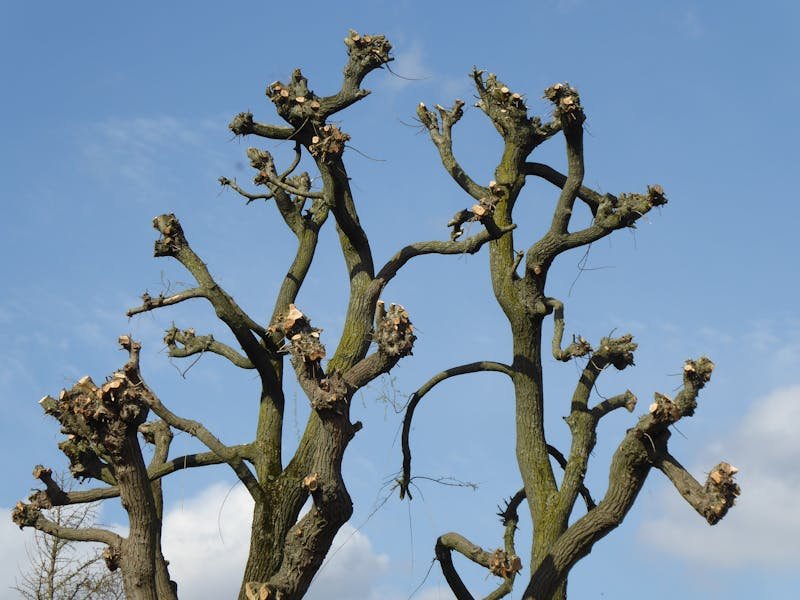
Topping is cutting a tree down to a uniform flat height, with no regard for branch structure. It is universally rejected by every certified arborist organization. It is also the most common bad pruning practice in Huntsville, showing up on crepe myrtles, Bradford pears, and unfortunately on mature oaks and pines the homeowner thought were "too tall."
Lion-tailing
Lion-tailing is stripping all of the inner branches off a limb, leaving only a tuft of foliage at the end. It looks tidy from the ground, which is why some unscrupulous tree services do it, but it is extremely damaging. Weight gets concentrated at the branch tips, dramatically increasing breakage risk. The canopy interior gets sun-scalded. If a tree service does this, do not hire them again.
Flush cuts
A flush cut is made tight against the trunk, removing the branch collar (the raised ring of tissue where a branch meets the trunk). The branch collar produces the wound-sealing tissue that closes a pruning cut. Take it off and the wound cannot heal, opening a path for decay straight into the trunk. Proper cuts go just outside the branch collar.
Stub cuts
The opposite of a flush cut. A stub leaves several inches of branch sticking out from the trunk. The stub dies back, decays, and feeds rot back into the trunk. You see this on storm-damaged trees someone "cleaned up" with a chainsaw without finishing the job.
Wrong time of year
The most common version is people pruning oaks in spring and summer because that is when they have time for yard work. Oak wilt does not care about your weekend schedule. Wait for winter.
Climbing spikes on trees you intend to keep
Spikes (also called spurs or gaffs) are metal points climbers strap to their boots to ascend a tree. They are fine for trees being removed. They are not appropriate for any tree you intend to keep. Each puncture is an entry point for decay. A real arborist climbs your tree using ropes and saddle. If a tree service shows up with spikes for a pruning job, ask them to leave.
Why topping is so destructive
People think topping a big tree makes it safer. The opposite is true.
When you top a tree, you create dozens of large wounds that cannot heal properly. Decay sets in immediately. The tree responds to the loss of leaf area by sending up rapid water-sprout growth from below the cuts. Those new sprouts are weakly attached and grow much faster than normal branches. Within five to seven years, you have a tree with multiple rapid-growth limbs all attached at the same weak points, riddled with internal decay, dramatically more likely to fail in a storm than the original tree.
Topped trees also lose energy reserves quickly. They have to rebuild leaf area fast just to survive, and many go into permanent decline. Most topped oaks and pines I see are dead or dying within 10 to 15 years. If a tree is genuinely too tall for its location, the answer is careful crown reduction by a trained arborist or removal. Topping is not a real option.
DIY versus professional pruning
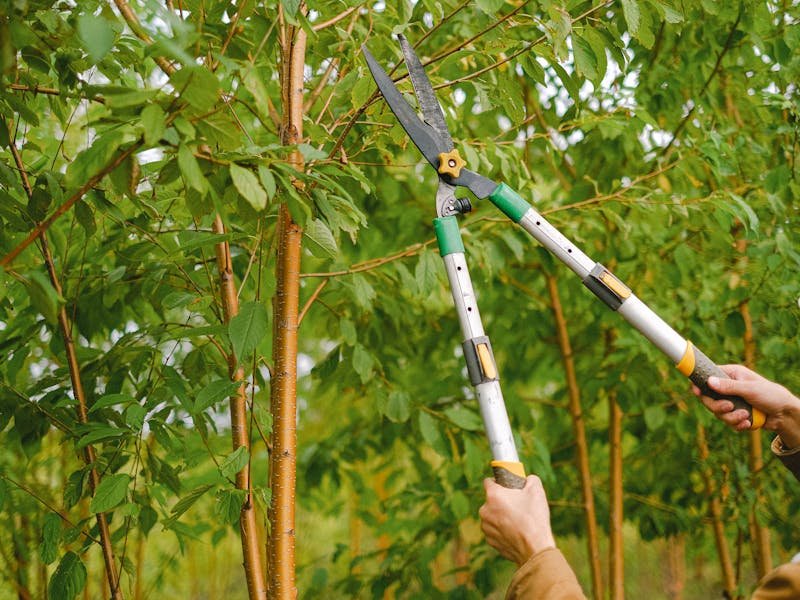
You can probably handle pruning yourself if all of these are true: the work is below 10 feet, you can do it from the ground or a short stable ladder, branches are smaller than 2 inches in diameter, the tree is not near power lines, and you understand how to make a proper three-cut on a larger limb.
Call a professional if any of these apply: you would need to climb the tree, you need a chainsaw, branches are larger than about 3 inches in diameter, the tree is anywhere near power lines, the tree is an oak that needs significant work, or you are not 100 percent sure where to make the cut. Working in a tree is genuinely dangerous, and the chainsaw injury rate among DIY homeowners is high. For most mature shade trees, hire a qualified tree trimming and pruning service.
How often to prune
For most mature shade trees in Huntsville, plan on pruning every 3 to 5 years. That schedule lets you catch dead wood and address structural issues without stressing the tree.
Young trees in their first 10 years benefit from structural pruning every 1 to 2 years. Catching co-dominant stems and crossing branches early is much easier than fixing them later. Fruit trees need annual pruning. Crepe myrtles need light annual pruning to clean up seed heads and crossing branches.
Resist the urge to prune just because it has been a while. If the tree looks healthy, has no dead wood, no rubbing branches, no clearance issues, and no structural problems, leave it alone. Pruning is a wound, even when done correctly. Do not wound a tree without a reason.
What to look for in a professional pruner
ISA certification. The International Society of Arboriculture certifies arborists, and a Certified Arborist has demonstrated knowledge of tree biology, pruning standards, and safety. You can verify any certification on the ISA website.
No spikes for pruning jobs. Proper insurance (general liability and workers' compensation). Ask for a certificate of insurance and verify it. An uninsured climber falling on your property is your problem.
A written, itemized plan. A real arborist will tell you specifically what they are doing: which type of pruning, which areas of the canopy, approximate percentage removed, and the reason. If the estimate just says "trim tree" with a price, that is a red flag. A formal arborist consultation before any major work is often worth the cost.
Cost ranges in Huntsville
Small trees (under 25 feet) generally run $150 to $400 per tree for routine pruning. Most ornamentals, fruit trees, and crepe myrtles fall here.
Medium trees (25 to 50 feet) typically run $300 to $700. Yard maples, smaller oaks, and similar.
Large trees (50 to 80 feet) generally run $700 to $1,500. Mature oaks, large pines, and tall hardwoods.
Very large or difficult trees (80+ feet, requiring cranes or complex rigging) can run $1,500 to $3,500 or more.
Pricing varies based on access, debris volume, height, and complexity. A tree right next to your house with a slate roof underneath costs more than the same tree in an open yard. Get at least two written estimates and pick based on the plan and credentials, not the price.
Wrapping up
The short version: prune for a reason, prune at the right time of year for the species, never take more than 25 percent of the canopy at once, never top a tree, and either learn the basics yourself or hire someone who clearly knows what they are doing.
If you have trees in Huntsville, Madison, or anywhere in the Tennessee Valley that need pruning, give us a call. We do honest assessments, we do not top trees, and we will tell you straight if your tree does not actually need work.